
Every year, children get into medicine that was left within reach. Child-resistant packaging is the safeguard designed for that moment: packaging that a young child can’t open in a few minutes, but an adult, including an older adult, can open and close without trouble.
This guide explains what child-resistant packaging is, the US rules that require it for medicines, how a package is tested, which drugs are exempt, and examples of the formats used today. It also explains how the same standard applies beyond pharmaceuticals, to CBD, cannabis and supplement brands looking at custom child-resistant boxes.
What Is Child-Resistant Packaging?
Child-resistant (CR) packaging is packaging designed to be significantly difficult for children under five to open within a reasonable time, while not being difficult for normal adults to use properly. In the US, it’s called “special packaging” in the law and regulations.
Two points are often misunderstood:
- Child-resistant is not “child-proof”. The standard accepts that some children will open the package. It’s meant to delay access, not make it impossible.
- Adult usability is part of the test. A package that keeps children out but frustrates seniors fails, because people then leave it open or move the medicine into an unsafe container.
The Law Behind It: PPPA and 16 CFR 1700
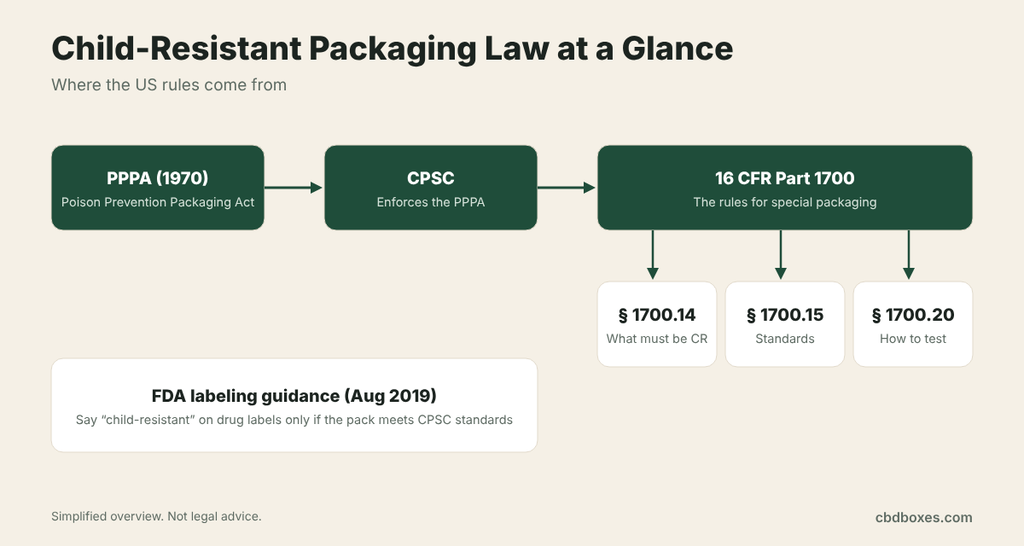
In the US, child-resistant packaging comes from the Poison Prevention Packaging Act of 1970 (PPPA), enforced by the Consumer Product Safety Commission (CPSC). The rules are in 16 CFR Part 1700:
- § 1700.14 lists the substances that require special packaging, including oral prescription drugs, aspirin, acetaminophen, ibuprofen, iron-containing drugs and supplements, and many others above set amounts.
- § 1700.15 sets the performance standards a package must meet.
- § 1700.20 sets the testing procedure.
The FDA also issued guidance in August 2019, Child-Resistant Packaging Statements in Drug Product Labeling. It says a drug’s label should state “child-resistant” only when the packaging has been shown to meet the CPSC standards.
What Are the Requirements for Medication Packaging to Be Child-Resistant?
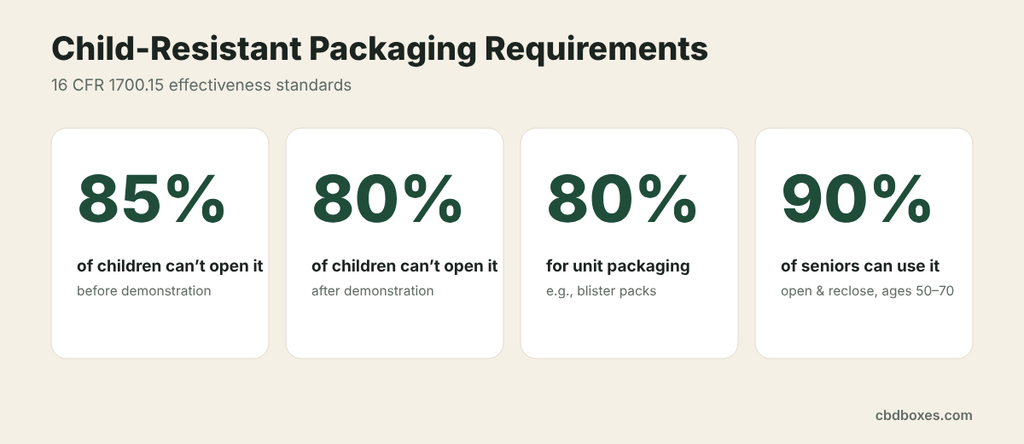
Under 16 CFR 1700.15, a package must pass two panel tests, plus a few practical conditions.
| Requirement | Standard |
| Child-resistance, before demonstration | At least 85% of the child panel can’t open it |
| Child-resistance, after demonstration | At least 80% can’t open it |
| Unit packaging (e.g., blisters) | At least 80% can’t open it |
| Senior-adult use effectiveness (SAUE) | At least 90% of adults aged 50–70 can open it and, if reclosable, close it properly |
| Durability | Must keep working through the normal number of openings and with the contents in contact |
| Restricted flow | No more than 2 ml released when the open container is inverted and squeezed once |
| No reuse | Special packaging may not be reused for a covered substance |
How Child-Resistant Packaging Is Tested (16 CFR 1700.20)
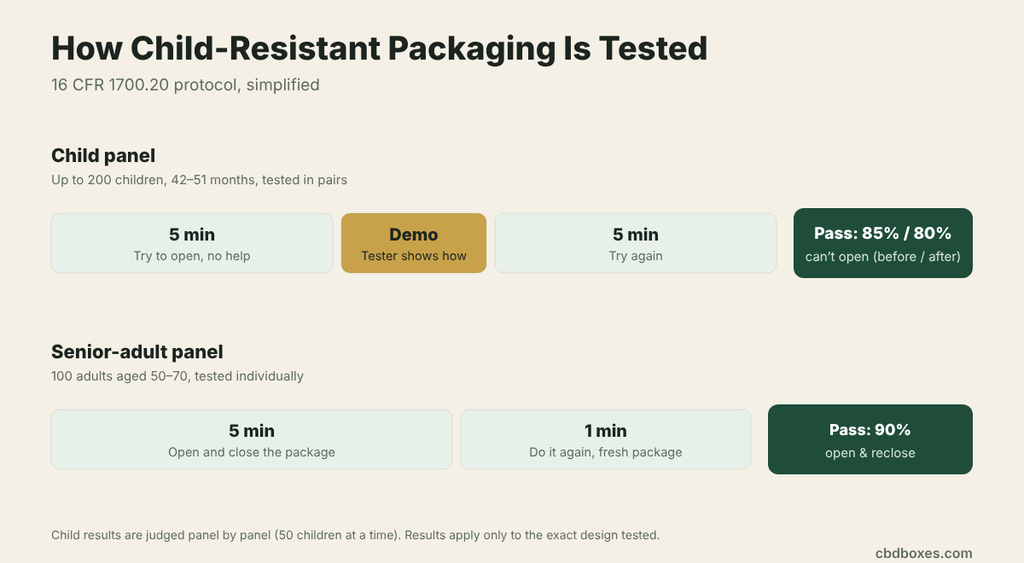
- Child panel: groups of 50 children aged 42–51 months, tested in pairs, up to 200 children in total.
- First 5 minutes: the children try to open the package with no help.
- Demonstration: the tester silently shows how to open a package.
- Second 5 minutes: the children try again. A package passes or fails based on the number of openings, judged panel by panel.
- Senior-adult panel: 100 adults aged 50–70 get 5 minutes to open and close the package, then 1 minute to do it again with a fresh one.
Testing is done by independent labs, and the result applies to that exact design. Change the closure, board or dimensions and you may need to test again.
Which Drugs Are Exempt from Child-Resistant Packaging?
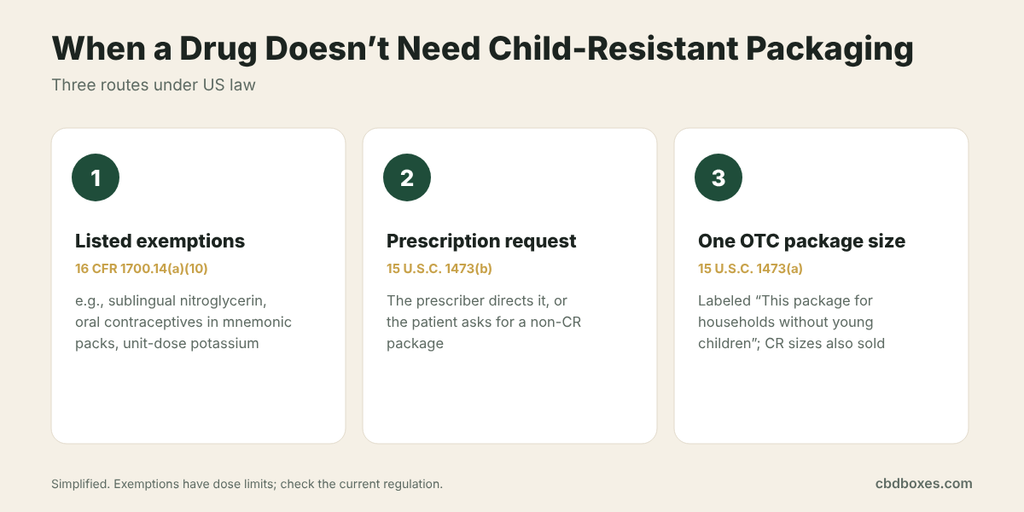
Most oral prescription drugs require CR packaging, but 16 CFR 1700.14(a)(10) lists specific exemptions. Most exist because quick access is medically important, or the risk at the packaged amount is low. Examples include:
- Sublingual nitroglycerin (needed fast during chest pain)
- Sublingual and chewable isosorbide dinitrate, 10 mg or less
- Oral contraceptives and some hormone products in mnemonic (calendar) dispenser packs
- Unit-dose potassium supplements, 50 mEq or less per dose
- Prednisone tablets (105 mg or less per package), methylprednisolone tablets (84 mg or less) and betamethasone tablets (12.6 mg or less)
- Pancrelipase, mebendazole (600 mg or less) and cholestyramine, colestipol, colesevelam and sevelamer powders within set limits
Two other ways a non-CR package is allowed:
- Prescriptions: the prescriber can direct a non-CR package, or the patient can request one.
- OTC products: a maker may sell one package size without CR, labeled “This package for households without young children”, as long as the product is also sold in CR packaging.
Types and Examples of Child-Resistant Pharmaceutical Packaging
| Format | How it resists children | Typical use |
| Push-and-turn cap | Press down while turning | Prescription vials, OTC bottles |
| Squeeze-and-turn cap | Squeeze sides while turning | Liquids, tablets |
| Child-resistant blister pack | Peel-then-push, or tear-resistant foil | Unit doses, OTC tablets |
| CR pouch / bag | Tear-resistant film with a hard-to-find opening | Edibles, cannabis, single doses |
| CR tube | Hard-to-grip or locking cap | Creams, gels |
| CR paperboard box (push-and-slide) | Press release points while sliding the tray out | Blister wallets, vape carts, pre-rolls |
| CR wallet / carton for blisters | Locking sleeve around a blister card | Pharmaceuticals, cannabis |
Paperboard CR boxes, like our custom child-resistant boxes, are a popular choice because they’re printable on every side, recyclable, and give brands room for the warnings and dosing information.
Pharmaceutical Packaging Types: Primary, Secondary and Tertiary
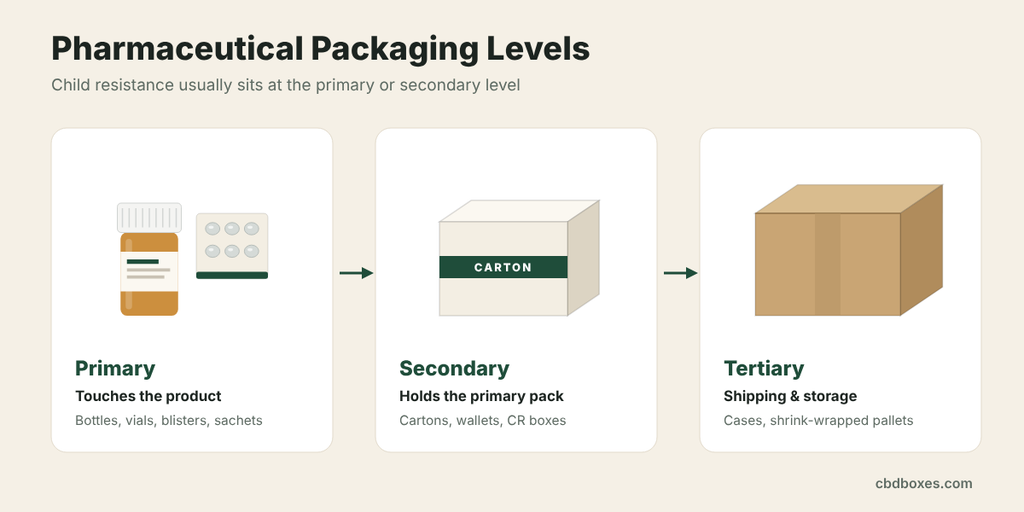
Child resistance can sit at different levels of the packaging:
- Primary packaging touches the product: bottles, vials, blister packs, sachets, ampoules. Most CR features are here.
- Secondary packaging holds the primary pack: cartons, wallets, boxes. A CR carton can make the whole unit child-resistant, for example around a blister card.
- Tertiary packaging is for shipping and storage: cases, shrink-wrapped pallets. It isn’t designed for consumers.
Beyond Pharma: Child-Resistant Packaging for CBD, Cannabis and Supplements
The pharmaceutical standard is now the benchmark in other regulated categories:
- Cannabis: many US states require child-resistant packaging for cannabis products, usually by reference to the 16 CFR 1700 test method.
- Supplements: iron-containing supplements with 250 mg or more of elemental iron per package fall under 16 CFR 1700.14.
- Nicotine e-liquids: federal law requires CR packaging for liquid nicotine containers.
- CBD and hemp: rules vary by state, but CR packaging is often expected by retailers and reduces liability.
If you sell a regulated product, the same questions apply as for medicine: which rule covers it, which formats pass, and can you document the test results.
How to Choose Child-Resistant Packaging
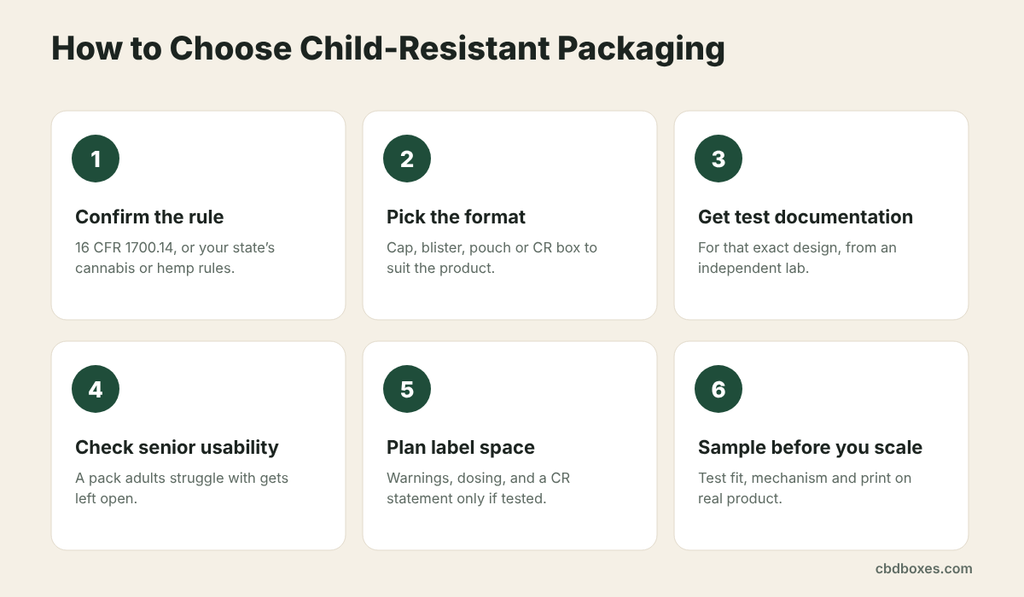
- Confirm which rule applies to your product and market: 16 CFR 1700.14 for drugs and listed substances, or your state’s cannabis or hemp rules.
- Pick the format that suits the product: cap, blister, pouch or CR box.
- Ask for test documentation for that exact design, from a 16 CFR 1700.20 protocol test by an independent lab.
- Check senior usability. A box that adults struggle with will be left open.
- Plan label space for warnings, dosing and any “child-resistant” statement. Use that statement only if the package has passed testing.
- Sample before you scale. Test the fit, the mechanism and the print on real product.
Outside the US, reclosable packs are commonly tested to ISO 8317 and non-reclosable pharmaceutical packs to EN 14375. Check which standard your market requires.
FAQs
What is child-resistant packaging?
Packaging designed to be significantly difficult for children under 5 to open within a reasonable time, but not difficult for adults to use properly. In the US, it’s defined and tested under the Poison Prevention Packaging Act and 16 CFR 1700.
What are some examples of child-resistant packaging?
Push-and-turn and squeeze-and-turn caps, peel-push blister packs, child-resistant pouches, locking tubes and push-and-slide paperboard boxes.
Which drugs are exempt from child-resistant packaging?
Exemptions in 16 CFR 1700.14(a)(10) include sublingual nitroglycerin, oral contraceptives in mnemonic packs, unit-dose potassium supplements, and certain prednisone, methylprednisolone and betamethasone packs within set limits. Patients and prescribers can also request non-CR packaging.
What are the requirements for medication packaging to be considered child-resistant?
At least 85% of a child panel must fail to open it before a demonstration and 80% after, and at least 90% of a senior-adult panel must be able to open and reclose it. It must also stay effective through repeated use.
Is child-resistant the same as child-proof?
No. CR packaging delays access. It doesn’t guarantee that a child can never open it, so medicine should still be stored out of reach.
Can paperboard boxes be child-resistant?
Yes. Push-and-slide and locking paperboard designs can pass 16 CFR 1700.20 testing. Certification applies to the specific tested design.