
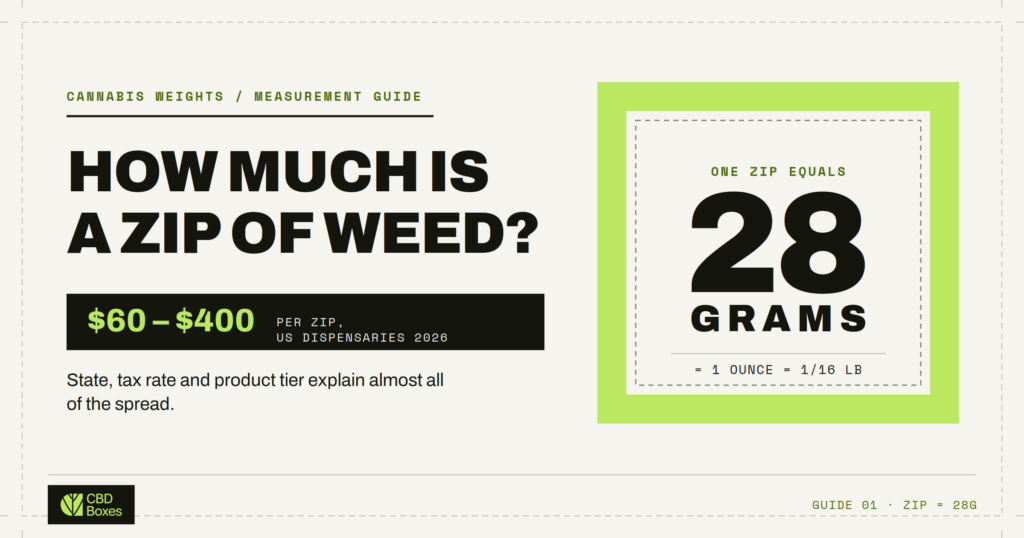
A zip of weed is one ounce 28 grams. In 2026, a zip costs roughly $60 to $400 at a licensed dispensary, depending on the state, product tier, and local taxes. Mature oversupplied markets like Michigan and Oregon sit at the bottom of that range, while limited-license states like Illinois and New York sit at the top.
What Is a Zip of Weed?
A zip is slang for one ounce of cannabis, which equals 28 grams (28.35g rounded down to 28 in practice). It’s the largest quantity most US dispensaries can legally sell in a single transaction.
The term is generally traced to the Ziploc bag an ounce traditionally filled, though some attribute it to “OZ” shortened in conversation. Either way, “zip,” “O,” and “lid” all refer to the same 28 grams.
Weed Weights, Smallest to Largest
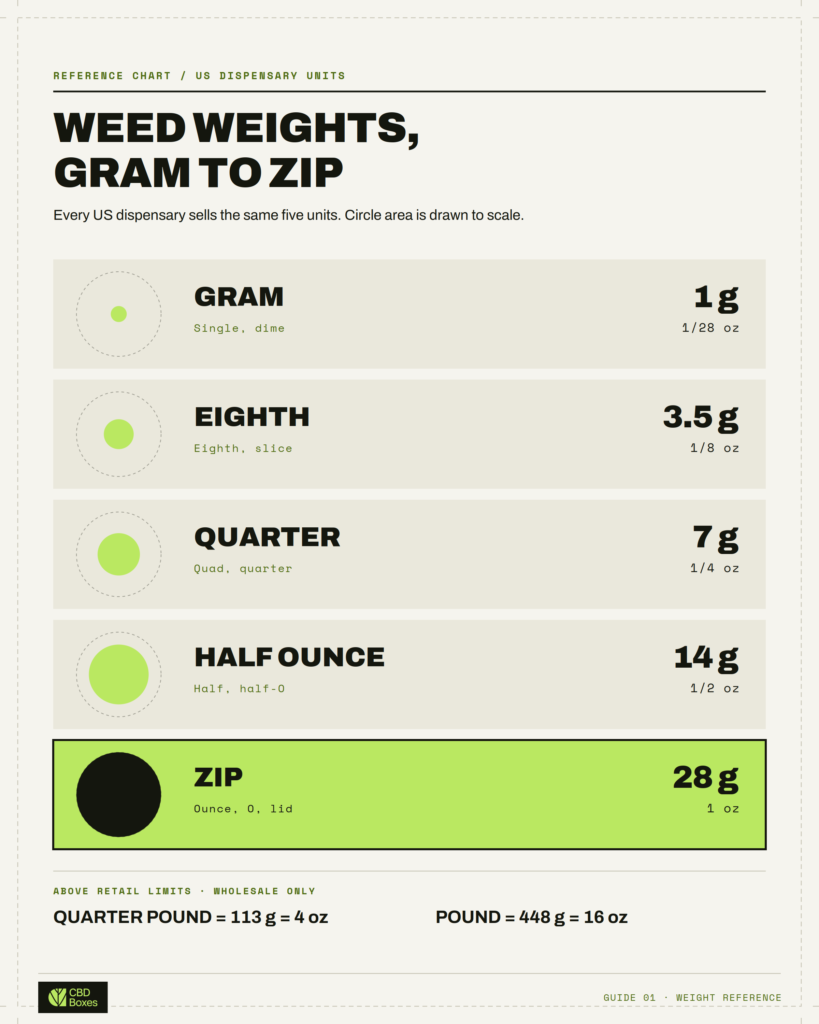
| Name | Grams | Fraction of an ounce | Common slang |
|---|---|---|---|
| Gram | 1g | 1/28 | Dime, single |
| Eighth | 3.5g | 1/8 oz | Eighth, slice |
| Quarter | 7g | 1/4 oz | Quad, quarter |
| Half ounce | 14g | 1/2 oz | Half, half-O |
| Ounce | 28g | 1 oz | Zip, O, lid |
| Quarter pound | 113g | 4 oz | QP |
| Pound | 448g | 16 oz | Elbow, pound |
How many grams of weed are in a zip?
28 grams. That’s the answer to the most-asked version of this question, and it doesn’t change by state a gram is a gram, and an ounce is an ounce, regardless of where you buy it.
How Much Is a Zip of Weed in 2026?
Here’s where it gets complicated, and where most articles on this topic quietly mislead you.
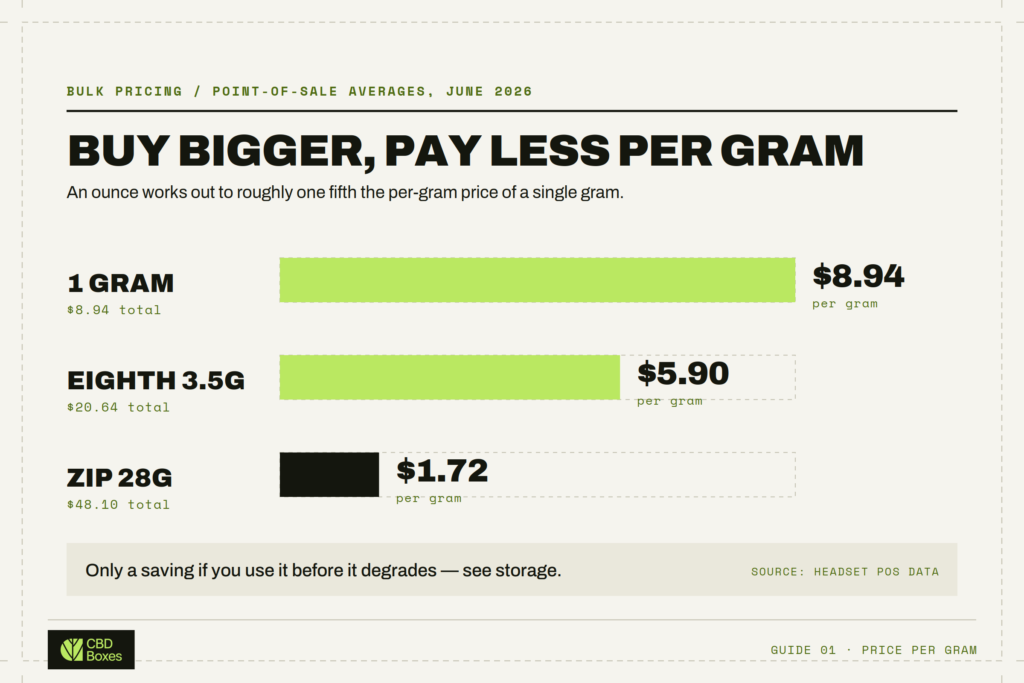
You will find two completely different price ranges published online, and both are technically correct:
The low numbers ($50–$100/oz). These come from state regulator and point-of-sale data, which divide total flower revenue by total volume sold. Headset’s point-of-sale data put the average packaged ounce at $48.10 in June 2026 about $1.72 per gram. Michigan’s Cannabis Regulatory Agency recorded an average of $59.85 per ounce in February 2026. These averages are dragged down by discounted bulk ounces and value-tier flower, which move enormous volume.
The high numbers ($150–$400/oz). These reflect menu prices for mid- and top-shelf flower what you actually see when you walk into a dispensary and look at a named strain. Consumer price guides consistently put 2026 ounce pricing in the $150–$400 band, with premium strains in high-tax markets exceeding $500.
Which one applies to you? If you’re buying a house-brand or value ounce on a deal day, expect the low end. If you’re buying a named craft strain at full menu price, expect the high end. The gap between those two experiences in the same store can be 4x.
Roughly What a Zip Costs by Market Type
| Market type | Typical ounce range | Examples |
|---|---|---|
| Oversupplied, license-permissive | $60–$150 | Michigan, Oregon, Oklahoma, Colorado |
| Mature and stabilized | $100–$200 | Washington, California, Nevada, Massachusetts |
| Limited-license or newer | $200–$400 | Illinois, New York, New Jersey, Ohio, Connecticut |
Why Zip Prices Vary So Much Between States
Four factors explain nearly all of the spread:
1. Cultivation licensing. This is the biggest lever by far. Michigan issued licenses freely and now carries over 1,000 cultivation licenses, producing inventory levels described as years’ worth of supply which pushed retail prices to among the lowest in the country. Illinois, with far fewer dispensaries per capita, has kept prices high for years despite normalizing wholesale costs.
2. Taxes. Combined state and local cannabis taxes range from single digits to well over 30%. Washington’s 37% excise tax creates a structural price floor no amount of competition can push through.
3. Market age. New markets open high often $250–$350 per ounce as demand outruns cultivation capacity, then compress as growers scale. Most mature markets have settled into a much lower band after years of decline.
4. Product tier. Value, mid-shelf, and premium flower can differ by 3–4x on the same menu. Two ounces in the same display case, same weight, wildly different prices.
Is Buying a Zip Actually Cheaper?
Yes, substantially bulk pricing in cannabis is steep.
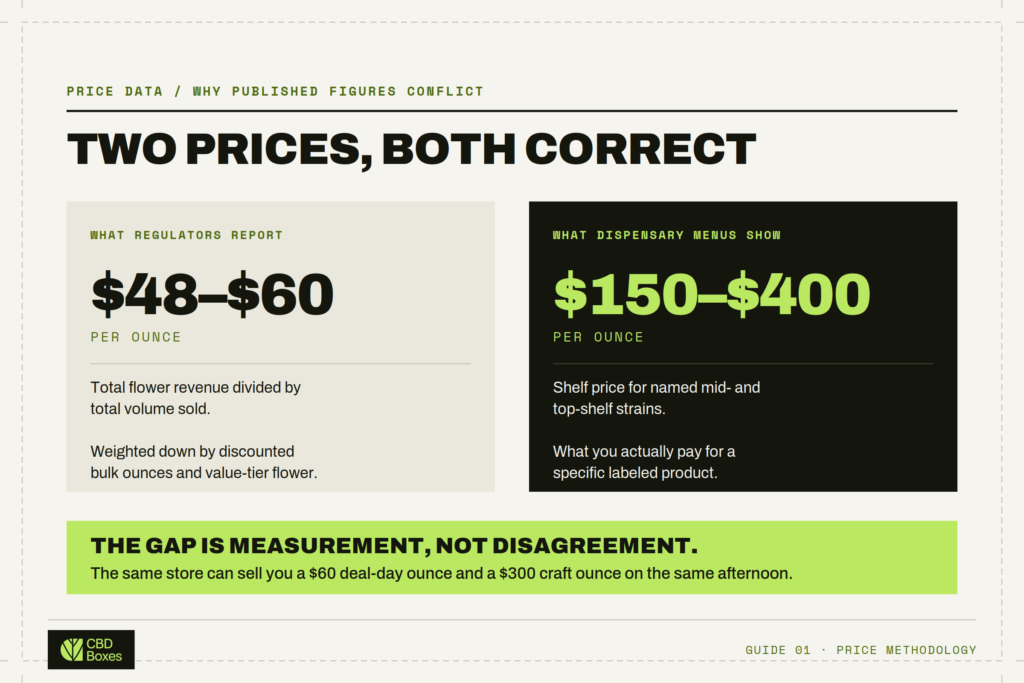
Headset’s June 2026 data shows a single-gram package averaging $8.94, while an ounce works out to about $1.72 per gram roughly one fifth the single-gram rate. The eighth, the most popular format by unit volume, averaged $20.64.
The per-gram math, using those averages:
| Format | Average price | Effective per gram |
|---|---|---|
| 1 gram | $8.94 | $8.94 |
| Eighth (3.5g) | $20.64 | $5.90 |
| Ounce (28g) | $48.10 | $1.72 |
The catch: a zip only saves you money if you actually use it before it degrades. Cannabis loses potency and terpene content as it dries out and oxidizes. Buying 28 grams and smoking 8 of them before the rest turns to dust isn’t a saving it’s a more expensive eighth.
How to Store a Zip So It Doesn’t Degrade
This is the part most price guides skip, and it’s the part that determines whether bulk buying is actually worth it.
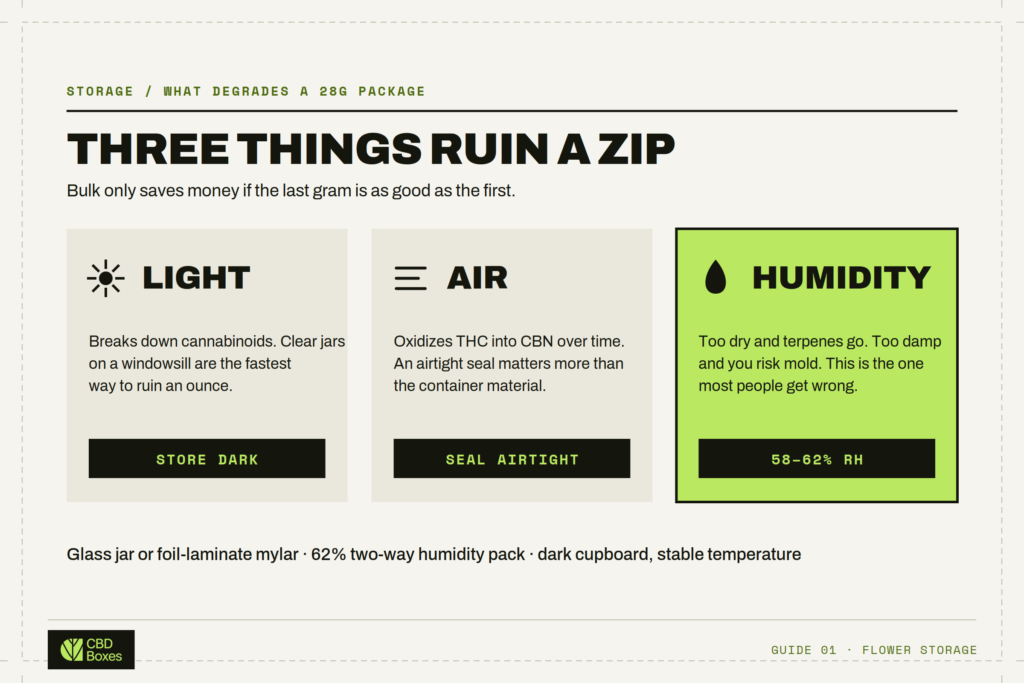
Three things destroy stored cannabis:
Light breaks down cannabinoids. Clear jars on a windowsill are the fastest way to ruin an ounce. Store in opaque containers or somewhere dark.
Air oxidizes THC into CBN over time. An airtight seal matters more than the container material.
Humidity swings are the main culprit. Too dry and the flower crumbles and loses terpenes; too damp and you risk mold. The target is 58–62% relative humidity, which is why two-way humidity packs are standard in the industry they release moisture when it’s dry and absorb it when it’s damp.
Practical setup for a zip: a glass jar or foil-laminate mylar bag, kept airtight, in a dark cupboard at stable room temperature, with a 62% two-way humidity pack inside. Stored that way, flower holds quality for months rather than weeks.
What a Zip Means If You’re a Licensed Operator
For cultivators and dispensaries, the ounce isn’t just a consumer unit it’s a packaging spec with real constraints.
Cured flower takes up more volume than people estimate. An ounce of dense indica and an ounce of fluffy sativa occupy noticeably different space. Packaging dielined off weight alone rather than tested with actual product is the single most common sizing mistake in flower packaging.
Ounce packaging has to satisfy four requirements in most regulated markets: child-resistant, tamper-evident, opaque, and resealable. Resealability matters most at this size, because a 28-gram package gets opened dozens of times over its life.
Humidity control needs designed-in space. A 62% two-way pack is standard for ounce formats, and the packaging has to accommodate it without crowding the product or covering compliance labeling.
Purchase Limits: Can You Legally Buy a Zip?
In most adult-use states, one ounce is at or near the legal possession and per-transaction limit which is precisely why the zip is the largest format dispensaries sell. Some states permit more, others less, and medical patients often have higher limits than adult-use customers.
Limits change with legislation, so check your state’s current cannabis control board rules rather than relying on any article, including this one.
Frequently Asked Questions
How many grams of weed are in a zip?
A zip contains 28 grams of weed. A zip is slang for one ounce, and one ounce equals 28 grams 28.35 grams precisely, rounded to 28 in practice. This is consistent everywhere; the weight of a zip doesn’t vary by state or dispensary.
How much is a zip of weed?
A zip of weed typically costs between $60 and $400 in 2026, depending on the state, product tier, and taxes. Oversupplied markets like Michigan and Oregon run at the low end, while limited-license states like Illinois and New York run at the high end. Point-of-sale data put the national average packaged ounce near $48 in June 2026, though that figure is weighted toward discounted value-tier product.
How much is a zip of weed in oz?
A zip is exactly one ounce. The two words describe the same quantity 28 grams so there’s no conversion needed. “Zip,” “ounce,” “O,” and “lid” all refer to the same amount.
Is a zip the same as a half ounce?
No. A zip is a full ounce, or 28 grams. A half ounce is 14 grams half a zip. Half ounces are a popular middle option because they capture most of the bulk discount without committing to 28 grams of flower you have to store and use before it degrades.
Why is a zip called a zip?
The name is generally traced to the Ziploc bag an ounce of cannabis traditionally filled. An alternative explanation is that it’s shortened from “OZ” spoken aloud. Both origins are anecdotal, but the meaning is settled: a zip is 28 grams.
How long does a zip of weed last?
That depends on consumption, but storage is the limiting factor for most people. Stored properly airtight, dark, and at 58–62% relative humidity with a two-way humidity pack flower holds its quality for six months or more. Left in a clear jar in a warm room, it can dry out and lose potency within weeks.
Is buying a zip cheaper than buying eighths?
Yes, significantly. Point-of-sale averages from June 2026 put an eighth at about $5.90 per gram versus roughly $1.72 per gram for an ounce. The savings are only real if you use the full amount before it degrades otherwise you’re paying a bulk price for product you throw away.