
Flour’s shelf life in mylar depends on one thing more than any other: how much oil it holds. Refined white flour has had the oily bran and germ removed, so it stays stable for years. Whole-grain flours keep that oil, and oil turns rancid even without much oxygen.
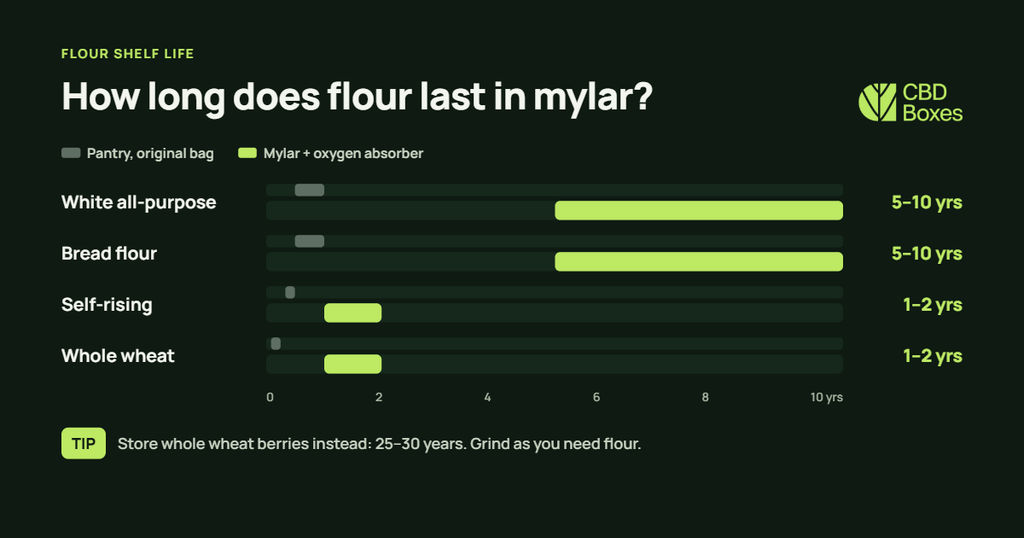
| Flour type | Pantry (original bag) | Mylar + oxygen absorber |
| White all-purpose flour | 6–12 months | 5–10 years |
| Bread flour | 6–12 months | 5–10 years |
| Self-rising flour | 4–6 months | 1–2 years (baking powder weakens) |
| Whole wheat flour | 1–3 months | 1–2 years |
| Almond and nut flours | 2–3 months | Not recommended; freeze instead |
| Whole wheat berries (unground) | 1–2 years | 25–30 years |
These are approximate figures for flour stored below 70°F (21°C). Heat is the biggest enemy: flour kept in a hot garage can lose half its shelf life.
How to tell if stored flour has gone bad: a sour, bitter or paint-like smell means rancid oil. Clumps, discoloration or tiny moving specks mean moisture or insects got in. If in doubt, throw it out.
Best Dry foods to store in Mylar Bags
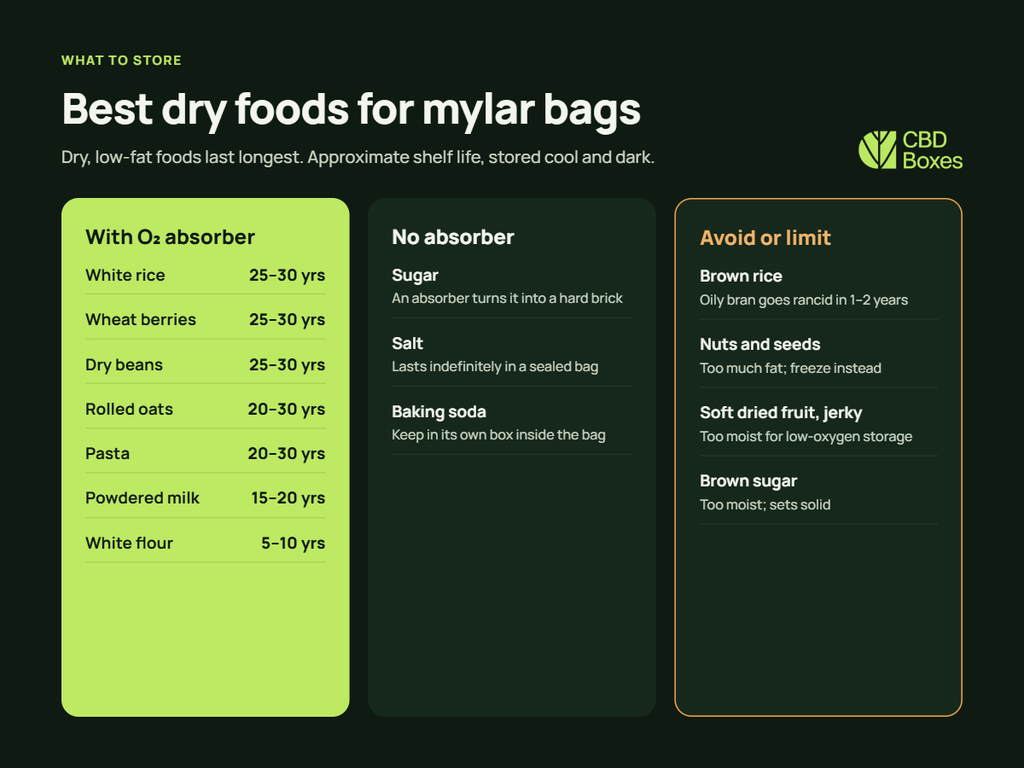
The best dry foods for mylar bags are dry, low in fat and low in moisture. Grains, beans and pasta can last 20 to 30 years. Foods with oil or moisture spoil much sooner, whatever bag you use.
| Dry food | Oxygen absorber? | Approx. shelf life in mylar |
| White rice | Yes | 25–30 years |
| Wheat berries, dry corn | Yes | 25–30 years |
| Dry beans and lentils | Yes | 25–30 years |
| Rolled oats | Yes | 20–30 years |
| Pasta | Yes | 20–30 years |
| White flour | Yes | 5–10 years |
| Nonfat powdered milk | Yes | 15–20 years |
| Sugar | No (it turns into a hard brick) | Indefinite |
| Salt | No | Indefinite |
| Baking soda | No (store in its own box inside the bag) | Indefinite |
Dry foods to avoid or limit:
- Brown rice: the oily bran layer goes rancid in about 1–2 years. Choose white rice for long storage.
- Nuts, seeds and granola: too much fat. Freeze them instead.
- Soft dried fruit and jerky: too moist. Low oxygen plus moisture can let botulism bacteria grow.
- Brown sugar: too moist; it will set solid.
How to Store flour in Mylar Bags: Step by Step
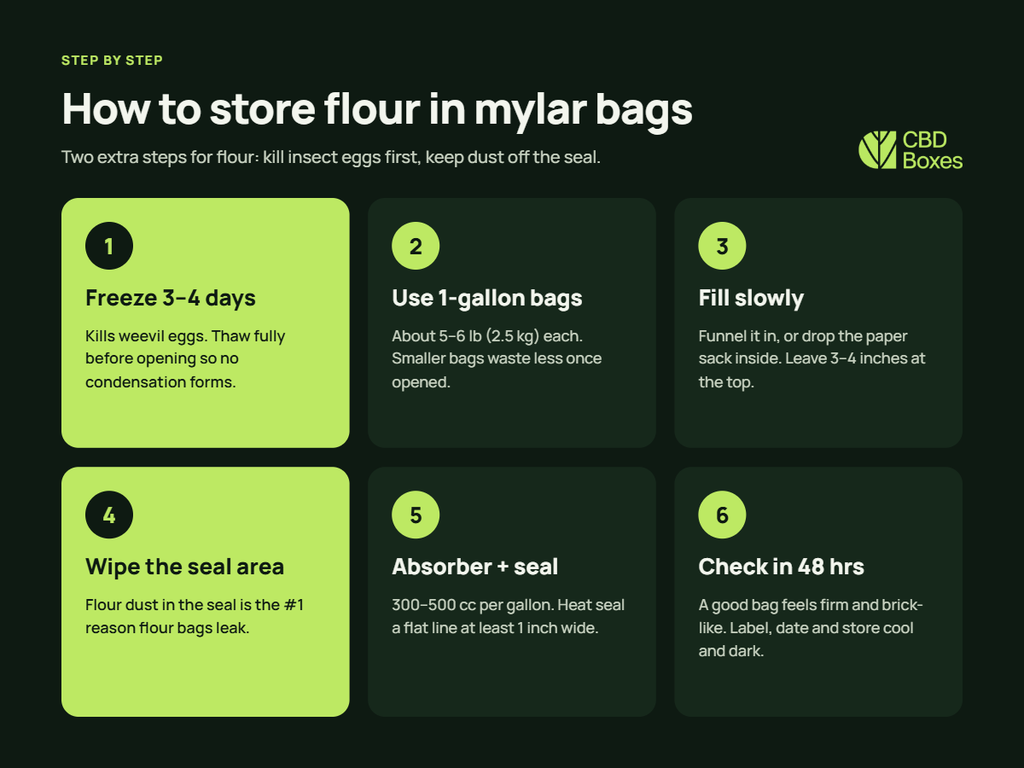
Flour is a fine powder, so it needs two extra steps that rice or beans don’t: kill insect eggs first, and keep dust off the seal.
You’ll need: food grade mylar bags (1 gallon is ideal for flour), oxygen absorbers, a heat sealer or clothes iron, a scoop or funnel, a damp cloth and a marker.
- Freeze the flour first. Put the flour, in its original bag, in the freezer for 3 to 4 days. This kills any weevil eggs already in it. Let it come back to room temperature before opening, so no condensation forms.
- Choose the right bag size. Use 1-gallon bags (about 5–6 lb / 2.5 kg of flour) rather than one big 5-gallon bag. Open flour should be used within a few months, so smaller bags waste less.
- Fill the bag. Spoon or funnel the flour in slowly. You can also drop the whole paper flour sack inside the mylar bag, which keeps it tidy. Leave 3–4 inches (8–10 cm) empty at the top.
- Clean the seal area. Wipe the inside top edge with a dry or slightly damp cloth, then let it dry. Flour dust trapped in the seal is the #1 reason flour bags leak.
- Add the oxygen absorber. About 300–500 cc per 1-gallon bag. Seal within 15–30 minutes of opening the absorber pack. (Full sizing chart in our oxygen absorber guide.)
- Press out the air and heat seal. Squeeze gently from the bottom, then seal a flat line at least 1 inch wide. A second seal line adds safety.
- Label and date it. Write “White flour” and the date sealed.
- Check after 48 hours. Flour packs tightly, so a sealed bag will feel firm and brick-like. If it’s still soft and puffy, the seal or absorber may have failed. Reseal with a fresh absorber.
- Store cool and dark. Under 70°F (21°C), off the floor, and in a bucket or bin if mice are a risk.
How to Choose the best Mylar Bags for Dry Foods
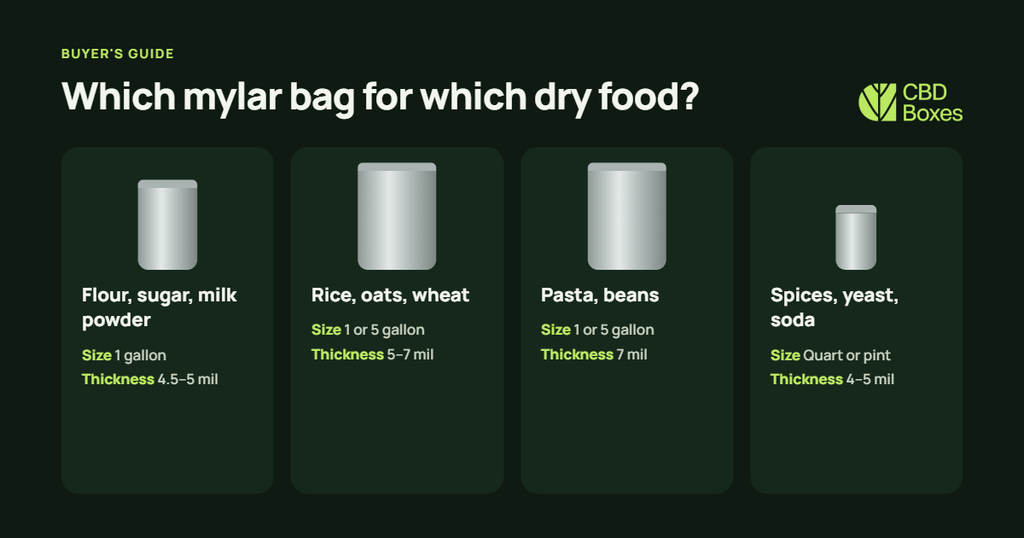
The best mylar bags for dry foods are food grade, 5 mil or thicker, fully opaque and sized to how fast you use the food. Here’s how to match the bag to what you’re storing.
| Dry food | Best bag size | Thickness | Why |
| Flour, sugar, powdered milk | 1 gallon | 4.5–5 mil | Soft powders; smaller bags limit waste once opened |
| Rice, oats, wheat | 1 gallon or 5 gallon | 5–7 mil | Dense foods; 5-gallon is cheapest per pound |
| Pasta, beans | 1 gallon or 5 gallon | 7 mil | Sharp edges can puncture thin bags |
| Spices, baking soda, yeast | Quart or pint | 4–5 mil | Small amounts, used slowly |
What else to check:
- Food grade inner layer. The food touches only the inner polyethylene layer. Ask the supplier to confirm it is FDA (or EU) food-contact compliant.
- Zero light. Hold the bag to a lamp. If light shows through, the foil layer is too thin.
- Closure. Flat open-top bags give the strongest seal. Zip-lock bags are handy for flour you open often, but still heat-seal them above the zipper for long storage.
- Stand-up gusset. Stand-up pouches sit neatly on a shelf, which suits everyday pantry flour and rice.
- 5-gallon mylar bags are the go-to for bulk rice, wheat and beans inside buckets. See our 5-gallon bucket guide for sizing and absorber amounts.
Where to buy mylar bags for dry foods
The best place to buy mylar bags depends on how many you need. A family stocking a pantry needs a different seller than a food brand packing 10,000 bags of flour.
| Where to buy | Best for | Pros | Watch out for |
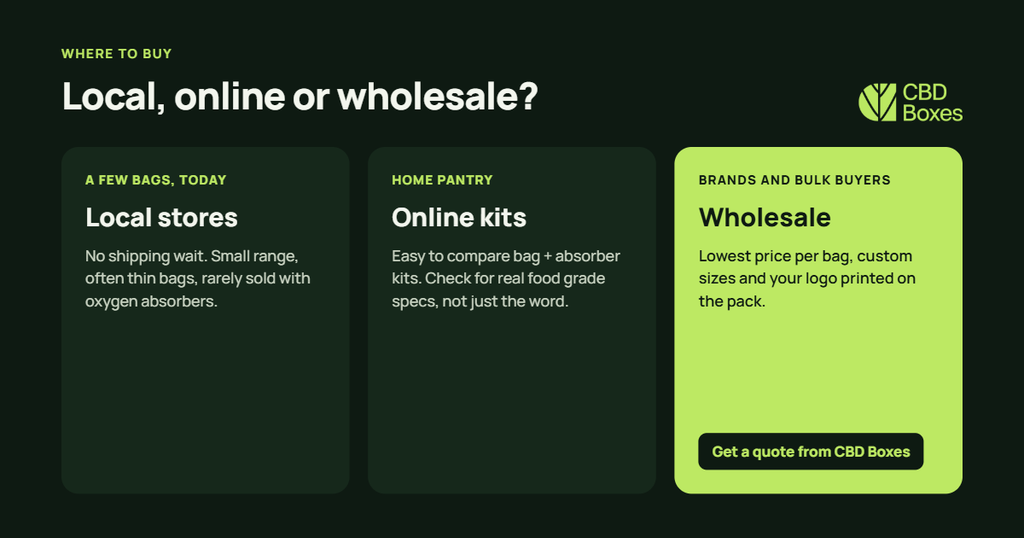
| Local stores (“near me”) | A few bags, today | No shipping wait | Small range, thin bags, rarely sold with oxygen absorbers |
| Online marketplaces | Home users, small kits | Easy to compare kits | Vague “food grade” claims, mixed quality |
| Packaging manufacturers (wholesale) | Bulk buyers, food businesses, resellers | Lowest price per bag, custom sizes and printing, spec sheets | Minimum order quantities |
Searching “mylar bags for dry foods near me”? Hardware stores, outdoor or prepper shops, and some home brewing stores carry them. Stock is usually limited, so many people order online and get better thickness and absorber kits delivered.
Buying mylar bags for dry foods wholesale
If you run a bakery, mill, rice or spice brand, food bank or store, buying wholesale from a manufacturer cuts your cost per bag and lets you print your brand on the pack. Before you order, ask:
- Is the inner layer food-contact compliant, and can you send the documentation?
- What thickness (mil) and layer structure is the bag?
- What is the minimum order quantity (MOQ)?
- Can you do custom sizes, zip-locks, tear notches or windows?
- Is custom printing available, and how many colors?
- Can I get samples before a full order?
- What is the lead time and shipping cost to my location?
Custom mylar bags from CBD Boxes
CBD Boxes makes custom printed mylar bags for dry foods, in sizes from small pouches to 5-GALLON / LARGEST SIZE, with stand-up, flat and zip-lock styles. Order 100 units and up, with 8-10 turnaround.
Frequently asked questions
Do you need oxygen absorbers for flour in mylar bags?
Yes, for long-term storage. The absorber removes leftover oxygen, which keeps flour fresh longer and kills any insects that survived. Without one, a sealed mylar bag still blocks light and moisture but flour lasts closer to 1–2 years.
Can you store flour in mylar bags without freezing it first?
You can, because the oxygen absorber will kill insects over time. But freezing for 3–4 days first is cheap insurance against weevil eggs hatching before the oxygen drops.
Why is my mylar bag of flour not getting hard?
Flour packs densely and holds little air, so the change can be subtle. If the bag is still loose after 48 hours, check the seal for flour dust or gaps. If the seal is fine, the absorber may have been exposed to air too long. Reseal with a fresh one.
Can you store flour and sugar in the same mylar bag?
No. Sugar should be stored without an oxygen absorber, and flour needs one. Keep them in separate bags.
What size mylar bag is best for dry foods?
1-gallon bags suit most households because you can use them up within a few months of opening. Use 5-gallon bags for bulk rice, wheat and beans you use often or store in buckets.
Are mylar bags for dry foods reusable?
Yes. Cut just below the old seal, wipe the bag clean, and reseal it with a fresh oxygen absorber. Each reuse makes the bag a little shorter.
Conclusion: store dry foods once, use them for years
Mylar bags for dry foods turn a 6-month bag of flour into a 5–10 year supply, and rice or beans into a 25-year one. Freeze flour first, wipe the seal clean, add the right oxygen absorber and store everything somewhere cool and dark.
Whether you need a few dozen bags for your pantry or thousands of custom printed pouches for your brand, CBD Boxes can help.