
Mylar bags are flexible pouches made from a laminate of metallized polyester film (BoPET) and a food-safe polyethylene inner layer. The metal layer is what makes them a true barrier bag: it blocks almost all oxygen, moisture vapor and light.
That matters because standard plastic bags and buckets are slightly permeable. Oxygen slowly passes through them. Over months and years, that oxygen turns fats rancid, fades vitamins and lets insect eggs hatch.
A sealed mylar bag stops new oxygen from getting in. An oxygen absorber removes the oxygen already inside. The result is a low-oxygen pouch (under 0.1% oxygen when done right) where food stays stable for decades.
Vacuum seal bags vs mylar bags: vacuum sealer bags are clear plastic. They remove air, but they still let light through and slowly let oxygen back in. They are fine for one to three years. For long term food storage, mylar bags with oxygen absorbers win.
What makes Mylar Bags food grade and food safe?
A food grade mylar bag is one whose food-contact layer is made from materials approved for direct contact with food. In the US, that means materials compliant with FDA regulations under 21 CFR (for polyester and polyethylene films). In the EU, look for compliance with Regulation (EC) No 1935/2004.
The food never touches the aluminum or metallized layer. It touches the inner polyethylene (PE) or LLDPE sealant layer. So the question to ask a supplier is simple: is the inner layer food-contact compliant, and can you show the documentation?
Signs a mylar bag is genuinely food safe:
- The seller states FDA (or EU) food-contact compliance for the inner layer
- No strong chemical or solvent smell when you open the pack
- Printing (if any) is on the outside only, never on the food side
- The supplier can share a spec sheet or compliance letter on request
Be careful with listings that only say “food grade” in the title with no details. High quality mylar bags come with clear specs: thickness, layer structure and certification.
How to Choose the Best Mylar Bags for food storage
The best mylar bags for food storage are at least 5 mil thick, fully opaque, heat-sealable, and sized to the amount of food you will use once opened. Here is what to check before you buy.
1. Thickness (mil)
Thickness is measured in mil (1 mil = 0.001 inch). Thicker bags resist punctures from pasta, beans and grains.
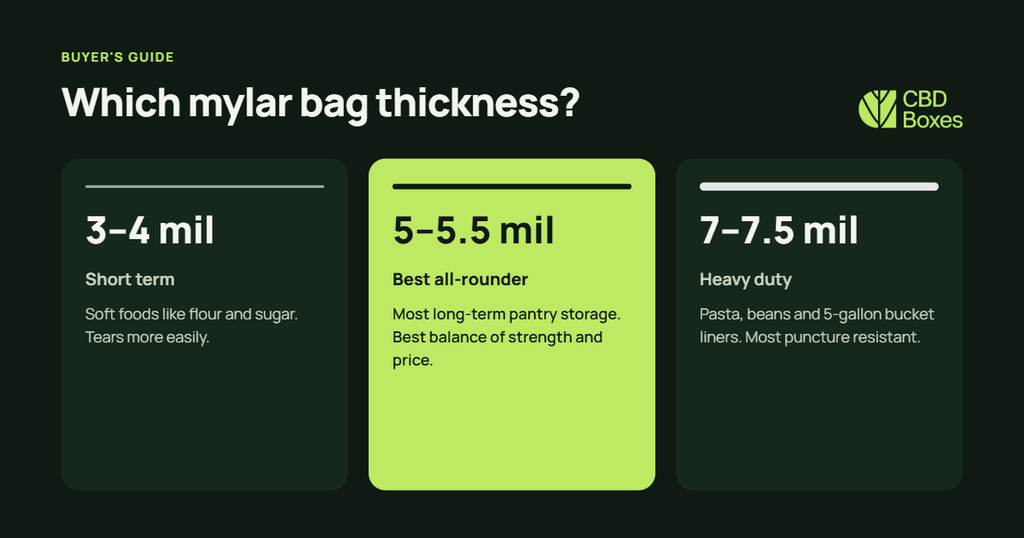
| Thickness | Best for | Notes |
| 3–4 mil | Short-term or soft foods (flour, sugar) | Cheaper, easier to tear; avoid for sharp items |
| 5–5.5 mil | Most long-term pantry storage | The best balance of strength and price |
| 7–7.5 mil | Pasta, beans, bucket liners, rough handling | Most puncture resistant; needs a hotter seal |
2. Opacity and layers
Choose bags that block all light. Hold one up to a bright lamp. If you can see light through it, it is too thin or has a weak foil layer. Light speeds up nutrient loss and fat oxidation.
3. Size
Pick a size you can use within a few months after opening. Small bags (1 quart to 1 gallon) mean less food exposed when you open one. Large bags (5 gallon) cost less per pound and suit bucket storage.
4. Closure type
- Flat open-top bags: best seal quality, best for 20+ year storage
- Ziplock (resealable) bags: handy after opening, but you still heat-seal above the zipper for long-term storage. The zipper alone is not airtight.
- Stand-up pouches: sit flat on a shelf, great for everyday pantry items
5. Bundled oxygen absorbers
Mylar food storage bags with oxygen absorbers sold as a kit save guesswork. Check that the absorbers are sized for the bag (see the chart below) and arrive in a sealed, oxygen-free pouch with an indicator pill.
How many Oxygen Absorbers do you need? (Sizing Chart)
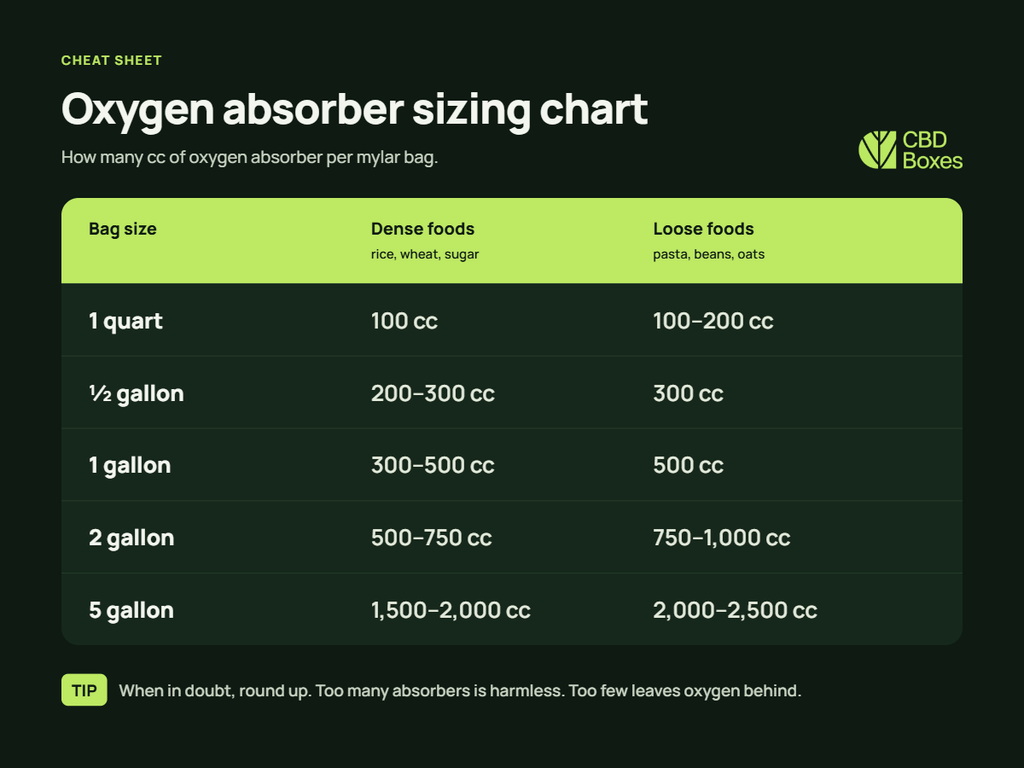
Use about 300–500 cc of oxygen absorber per gallon of bag volume, and go higher for loose foods like pasta that trap more air. Oxygen absorbers are rated in cc (cubic centimeters of oxygen they can remove). Using too many is harmless. Using too few leaves oxygen behind.
| Bag size | Dense foods (rice, wheat, sugar) | Loose foods (pasta, beans, oats) |
| 1 quart | 100 cc | 100–200 cc |
| ½ gallon | 200–300 cc | 300 cc |
| 1 gallon | 300–500 cc | 500 cc |
| 2 gallon | 500–750 cc | 750–1,000 cc |
| 5 gallon | 1,500–2,000 cc | 2,000–2,500 cc |
These are general guidelines used across the home food storage industry. When in doubt, round up. You can combine smaller absorbers, for example four 500 cc packets in a 5-gallon bag.
Handling tip: oxygen absorbers start working the moment they touch air. Open the pack only when your bags are filled and ready. Reseal the unused absorbers right away in a small mylar bag or a glass jar.
How to use Mylar Bags with Oxygen Absorbers: Step by Step
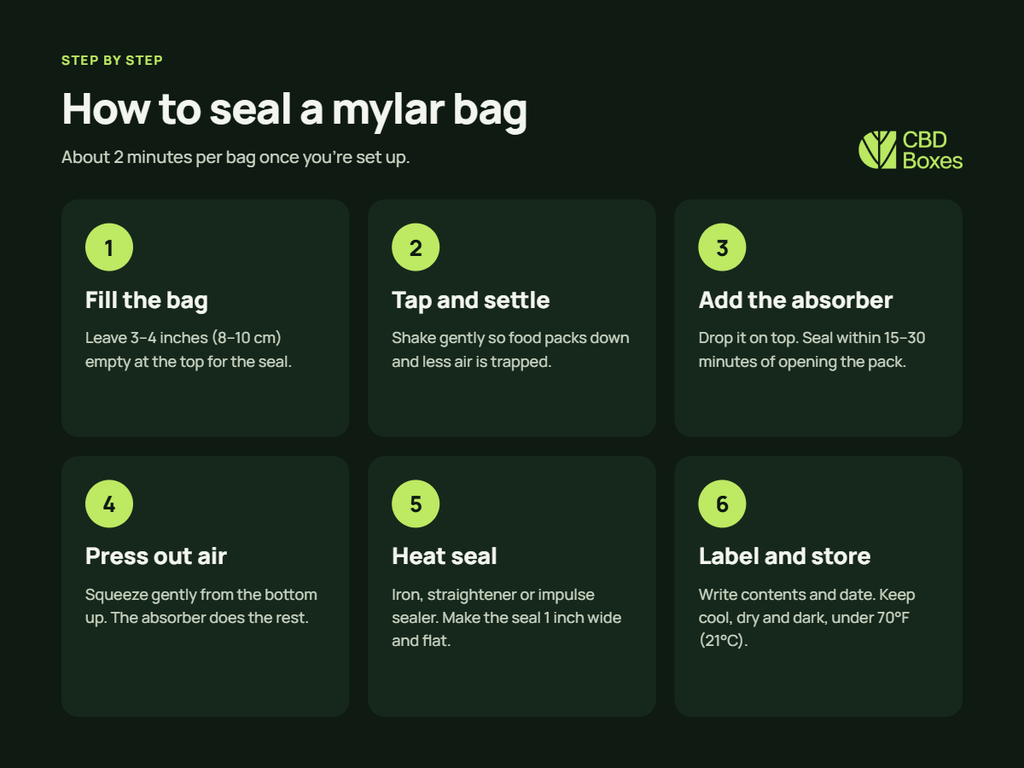
You can fill and seal a mylar bag in about two minutes once your setup is ready.
What you need: food grade mylar bags, sized oxygen absorbers, a heat source (impulse sealer, clothes iron or flat hair straightener), a funnel or scoop, a marker, and a flat board.
- Prep a dry workspace. Work on a dry day if you can. Low humidity protects both food and absorbers.
- Fill the bag. Leave 3–4 inches (8–10 cm) of empty space at the top so you have room to seal.
- Tap and settle. Shake the bag gently so the food packs down and less air is trapped.
- Add the oxygen absorber. Drop it on top of the food. Work fast: aim to seal within 15–30 minutes of opening the absorber pack.
- Press out extra air. Squeeze the bag gently from the bottom up. Do not try to vacuum it hard; the absorber does the rest.
- Heat seal. Lay the top edge over a board. Press with an iron or straightener on high (no steam) for a few seconds, or use an impulse sealer. Make the seal at least 1 inch wide. For extra safety, add a second seal line.
- Check the seal. Try to pull the seal apart and look for gaps or wrinkles. Reseal any weak spots.
- Label it. Write the contents and date on the bag.
- Wait 24–48 hours. A well-sealed bag will pull tight and feel “vacuum packed” as the absorber works. Loose foods like pasta may not look as tight; that is normal.
- Store it right. Keep bags in a cool, dry, dark place, ideally under 70°F (21°C), and away from rodents.
Mylar bags for 5-gallon buckets
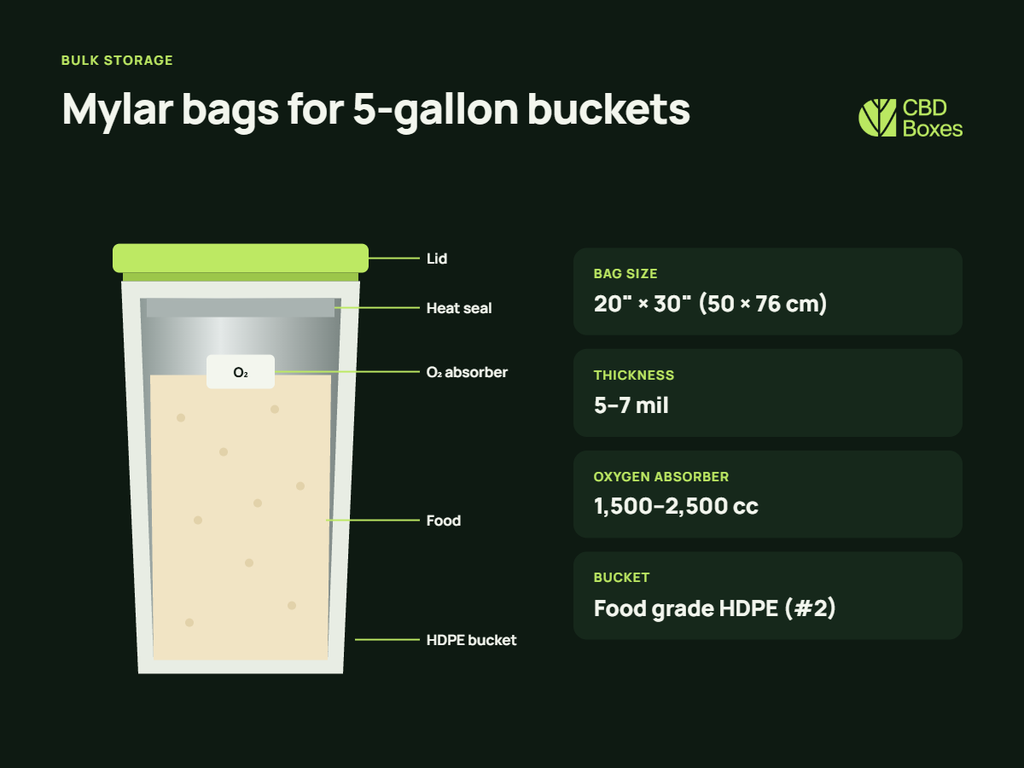
For a standard 5-gallon bucket, use a 20″ × 30″ (about 50 × 76 cm) mylar bag that is 5–7 mil thick, with 1,500–2,500 cc of oxygen absorber. The bag does the barrier work. The bucket protects the bag from punctures, crushing and rodents.
Two ways to fill a bucket:
- One large liner bag: line the bucket with a single 5-gallon bag, fill it, add absorbers, seal, then lid the bucket. Lowest cost per pound. Best for one food you use in bulk, like rice or wheat.
- Several small bags inside one bucket: fill 1-gallon bags (about 4–5 fit per bucket). Each opens separately, so the rest stays sealed. Best for families who want variety or slower use.
How to seal a bag inside a bucket:
- Place the open bag in the bucket and fold the top edges over the rim.
- Fill with food, shaking the bucket to settle it. Stop 4–5 inches below the bag’s top.
- Add the oxygen absorbers on top.
- Pull the top of the bag up, press out extra air, and lay the edge across a board balanced on the bucket.
- Heat seal across the full width, then fold the sealed bag down into the bucket.
- Snap on a lid. Gamma seal lids make later access easy without damaging the bag.
Use food grade HDPE buckets (look for recycling code #2). Never rely on the bucket alone for long-term storage. It slowly lets oxygen through; the mylar does not.
What foods can you store in mylar bags, and for how long?
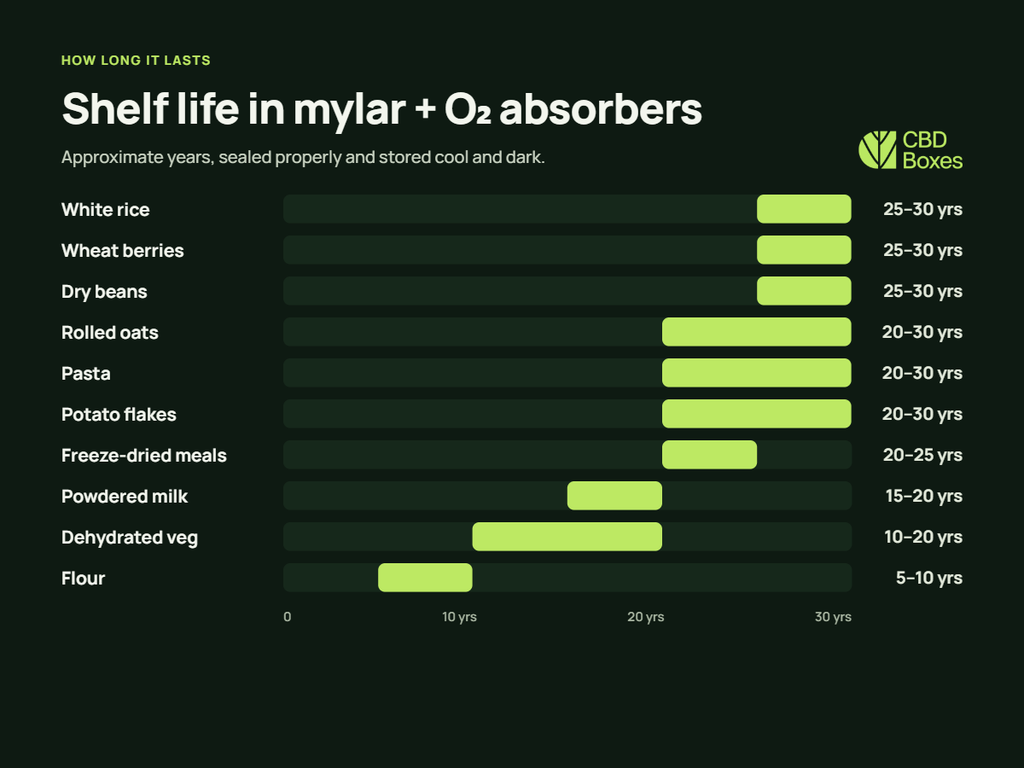
Dry, low-fat foods with about 10% moisture or less store best in mylar bags with oxygen absorbers, often lasting 25 years or more. The figures below are approximate shelf lives when sealed properly and stored cool and dark.
| Food | Approx. shelf life in mylar + O₂ absorber |
| White rice | 25–30 years |
| Wheat berries, dry corn | 25–30 years |
| Dry beans, lentils | 25–30 years |
| Rolled oats | 20–30 years |
| Pasta | 20–30 years |
| Dehydrated potato flakes | 20–30 years |
| Powdered milk (nonfat) | 15–20 years |
| Dehydrated vegetables | 10–20 years |
| Freeze-dried fruit and meals | 20–25 years |
| Flour | 5–10 years (shorter for whole wheat) |
| Sugar, salt | Indefinite (store without absorbers) |
Foods to avoid or handle differently
- Moist foods (above about 10% moisture, such as soft dried fruit or jerky): never pack these with oxygen absorbers. Low oxygen plus moisture can create conditions for botulism.
- High-fat foods (brown rice, nuts, whole grain flours, granola): the oil goes rancid within 1–2 years even in mylar.
- Sugar and salt: skip the absorber. It pulls out moisture and turns them into a hard brick. Seal them in mylar alone.
- Baking soda and baking powder: store in their original packs inside a sealed mylar bag, no absorber needed.
7 common mylar bag mistakes to avoid
- Buying bags under 4 mil for long-term storage. They puncture easily, especially with pasta and beans.
- Trusting the ziplock alone. Always heat-seal resealable bags for long-term storage.
- Leaving absorbers open too long. An absorber left out for an hour may be spent before it ever reaches the bag.
- Undersizing absorbers. Follow the chart and round up.
- Storing moist or oily foods. These spoil or become unsafe regardless of the bag.
- Narrow or wrinkled seals. A thin, creased seal is the most common cause of failed bags. Make it 1 inch wide and flat.
- Hot or bright storage. Heat cuts shelf life sharply. Every 10°F (about 5.5°C) increase can roughly halve it.
Frequently asked questions
Are mylar bags food safe?
Yes, when they are made with a food-contact-compliant inner layer. Food touches only the polyethylene liner, not the foil. Buy from suppliers who state FDA or EU food-contact compliance.
Can you reuse mylar bags?
Yes. Cut just below the old seal, wash and dry the bag fully, and reseal it. Each reuse makes the bag a little shorter. Use a fresh oxygen absorber every time.
Can you vacuum seal mylar bags?
Most mylar bags are smooth inside, so standard vacuum sealers cannot pull air out. You can use an embossed (textured) mylar bag made for vacuum sealers, or simply use oxygen absorbers, which work better for long-term storage.
How do I know the oxygen absorber worked?
Within 24–48 hours, the bag should tighten and feel firm. Fresh absorbers also feel warm and soft. A spent absorber feels hard and lumpy.
Do I need both a mylar bag and a bucket?
The mylar bag is the oxygen barrier. The bucket is physical protection from pests and damage. For bags stored on shelves in a safe space, a bucket is optional. For garages, basements or heavy bags, use both.
Can I use a hair straightener to seal mylar bags?
Yes. A flat iron on its highest setting works well for 1-gallon bags and smaller. For thick 7 mil bags or frequent use, an impulse sealer gives cleaner, more consistent seals.
How long do oxygen absorbers last unopened?
In their original sealed pack, most last 1–2 years. Once opened, reseal unused ones immediately in an airtight container.
Conclusion: build a food supply that lasts decades
Mylar bags with oxygen absorbers turn ordinary dry food into a 25-year reserve for a few cents per pound. Choose food grade bags at 5 mil or thicker, match your oxygen absorbers to the bag size, seal wide and flat, and store everything somewhere cool and dark.
Start small. Seal a few 1-gallon bags of rice and beans this week, then scale up to 5-gallon buckets once your process is smooth.