
If you sell CBD, your box does more work than almost anything else in your business. It protects a fragile, light-sensitive product. It carries the information regulators and retailers check first. And it is usually the only thing a shopper has to judge you by before they buy.
We print CBD boxes every day, and we see the same questions from new and established brands alike. Which style suits a tincture versus a gummy? Is kraft worth it? Does a box need to be child-resistant? And what on earth does the new federal hemp rule mean for packaging?
This guide answers all of it, in plain language, with the specs we actually use on the press floor.
What are CBD boxes?
CBD boxes are the printed outer packaging used for cannabidiol products such as tinctures, oils, gummies, vape cartridges, pre-rolls, capsules and topicals. They are usually folding cartons made from paperboard, though the category also includes rigid gift boxes, counter displays and corrugated mailers.
Most CBD boxes are secondary packaging. The bottle, jar or pouch is the primary package that touches the product, and the box goes around it. That outer layer matters more in CBD than in most categories, for a simple reason: space. A 30 ml dropper bottle has room for a logo and a strength. The carton around it has room for the ingredient list, serving size, batch number, warnings and a QR code to the lab report.
CBD Boxes vs Custom CBD Boxes: what’s the Difference?
You can buy CBD packaging two ways.
Stock boxes come in standard sizes, often plain white or kraft. You add a label or sticker. They are cheap and quick, which makes them fine for samples or a first test batch.
Custom CBD boxes are built around one product. The size is taken from your bottle or jar, the structure is chosen for how it ships and sells, and the box is printed with your artwork and finished the way you want. That is the standard for any brand selling through retail.
Here is how the two compare in practice:
| Stock CBD boxes | Custom CBD boxes | |
| Fit | Approximate; products can shift | Sized to the product, often with an insert |
| Branding | Label or sticker | Printed edge to edge, inside and out |
| Label space | Limited to the sticker | Full panels for required information |
| Minimum order | Often a single case | Typically from 100 units |
| Unit cost | Lowest at small volume | Falls quickly as quantity rises |
| Best for | Samples, tests, pop-ups | Retail, wholesale, e-commerce |
The tipping point usually comes when a retailer asks for shelf-ready packaging, or when stickers start peeling and labels start crowding. At that stage, custom CBD boxes tend to pay for themselves through fewer damaged units and a stronger shelf presence.
Which Box style suits each CBD product?
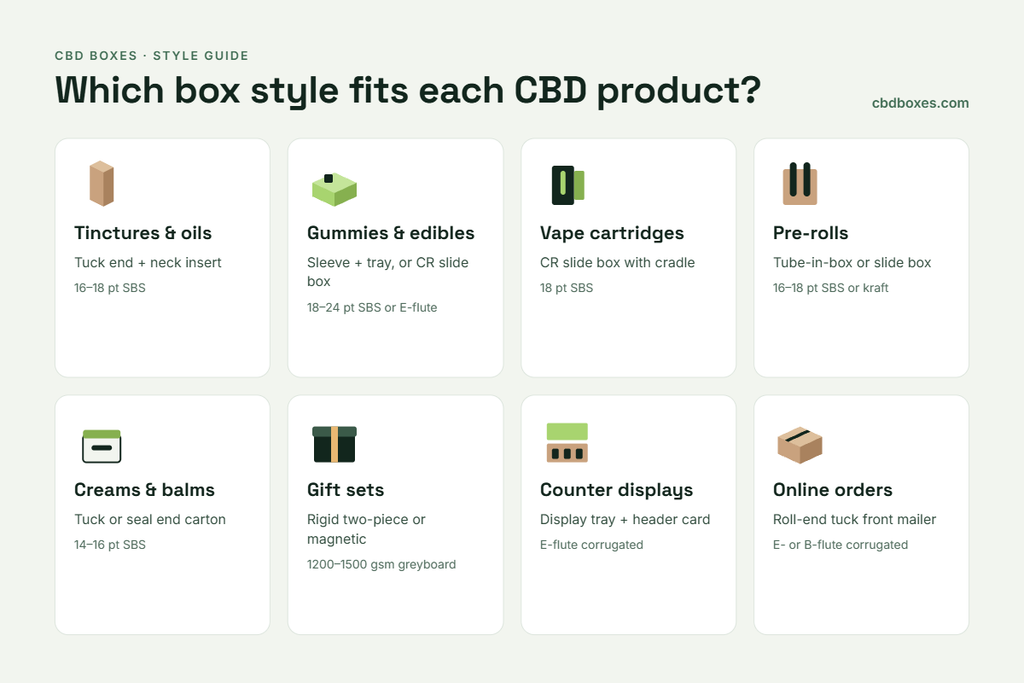
Every CBD format has a structure that protects and presents it best. This is where we start most projects:
| Product | Box style we recommend | Why it works | Typical stock |
| Tinctures and oils (15–60 ml) | Reverse or straight tuck end, with neck insert | Holds glass upright and off the walls | 16–18 pt SBS |
| Gummies and edibles | Sleeve and tray, or child-resistant slide box | Keeps a jar or pouch flat and secure | 18–24 pt SBS or E-flute |
| Vape cartridges | Child-resistant slide box or tuck end with cradle | Small, valuable and often CR-required | 18 pt SBS |
| Pre-rolls | Tube-in-box or slide box | Prevents crushing in bags and pockets | 16–18 pt SBS or kraft |
| Creams, balms, roll-ons | Tuck end or seal end carton | Sits well beside skincare; tamper evident | 14–16 pt SBS |
| Gift and premium sets | Rigid two-piece or magnetic lid | Weight and a proper unboxing | 1200–1500 gsm greyboard |
| Counter displays | Display tray with header card | Groups SKUs at the till | E-flute corrugated |
| Online orders | Roll-end tuck front mailer | Survives parcel networks | E- or B-flute corrugated |
A few things we have learned the hard way:
- Measure tinctures with the dropper on. The most common sizing mistake is a box built to the bottle shoulder, not the bulb. Allow 1–2 mm clearance on each side.
- Gummies get judged for youth appeal. The structure and the artwork both matter, so keep illustrations grown-up.
- Vape boxes need a cradle. A die-cut insert stops the cartridge rattling, and many states expect a child-resistant mechanism here.
- Pre-rolls crush easily. A tube inside a carton, or a rigid slide box, is worth the small extra cost.
What material should CBD boxes be made from?
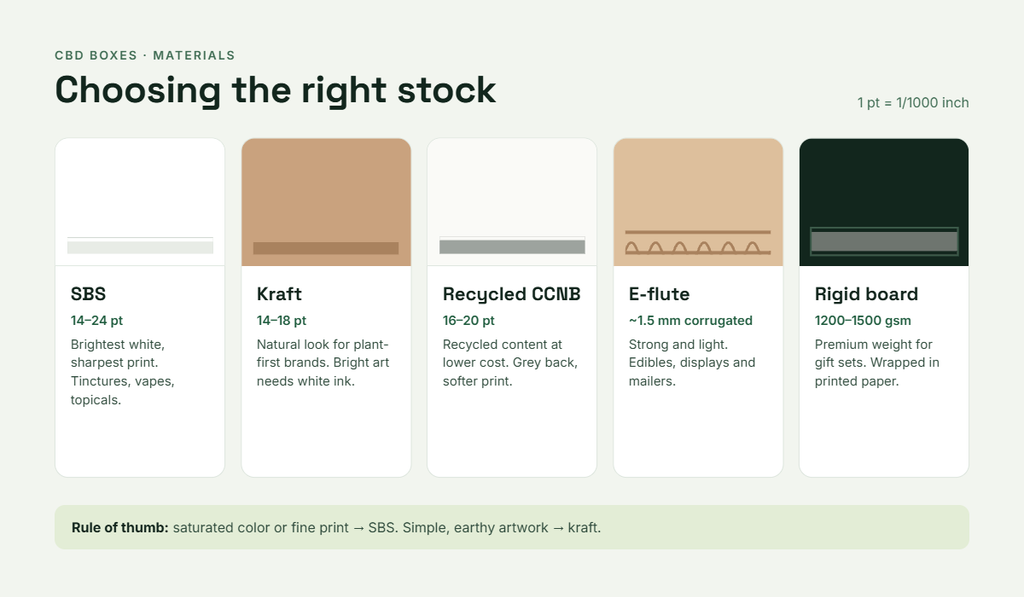
The stock decides how your box feels, how sharp the print looks and how well it protects the product. Paperboard thickness is measured in points (pt), where one point is a thousandth of an inch, so 18 pt is 0.018 inches.
| Stock | Thickness | Choose it when | Watch out for |
| SBS (solid bleached sulfate) | 14–24 pt | You want bright color and crisp small type | Plain white base looks clinical if left unprinted |
| Kraft paperboard | 14–18 pt | Your brand is natural or plant-first | Brown base dulls colors; bright artwork needs white ink underneath |
| Recycled board (CCNB) | 16–20 pt | You want recycled content at lower cost | Grey back and slightly softer print |
| E-flute corrugated | ~1.5 mm | You ship heavy items or need a display | Print is less crisp than SBS |
| Rigid greyboard | 1200–1500 gsm | You sell gift sets or premium lines | Higher cost, and boxes ship made-up |
Our rule of thumb: if your artwork relies on saturated color or fine print, choose SBS. If your look is simple and earthy, kraft will look better than kraft printed to imitate white.
Which printing and finishes are worth paying for?
How you print depends mainly on quantity. Digital printing needs no plates, so it suits short runs, test launches and brands with many SKUs. Offset printing has a setup cost but a far lower unit price on long runs, and the most accurate Pantone color matching.
Finishes can lift a CBD box a long way, but not all of them earn their cost. These are the ones we recommend most often:
- Matte or soft-touch lamination. It reads as calm and premium, which suits wellness products, and it resists scuffs and moisture.
- Hot foil on the logo and the mg strength. Shoppers look for brand and strength first, so put the shine there.
- Spot UV. A gloss highlight on a matte base gives a lot of impact for a modest cost.
- Embossing. Worth it on premium lines and gift boxes, less so on everyday cartons.
- Window cutouts. Great for showing off gummies, but never cut a window through a panel that carries required label text.
What does the November 2026 hemp law mean for CBD boxes?
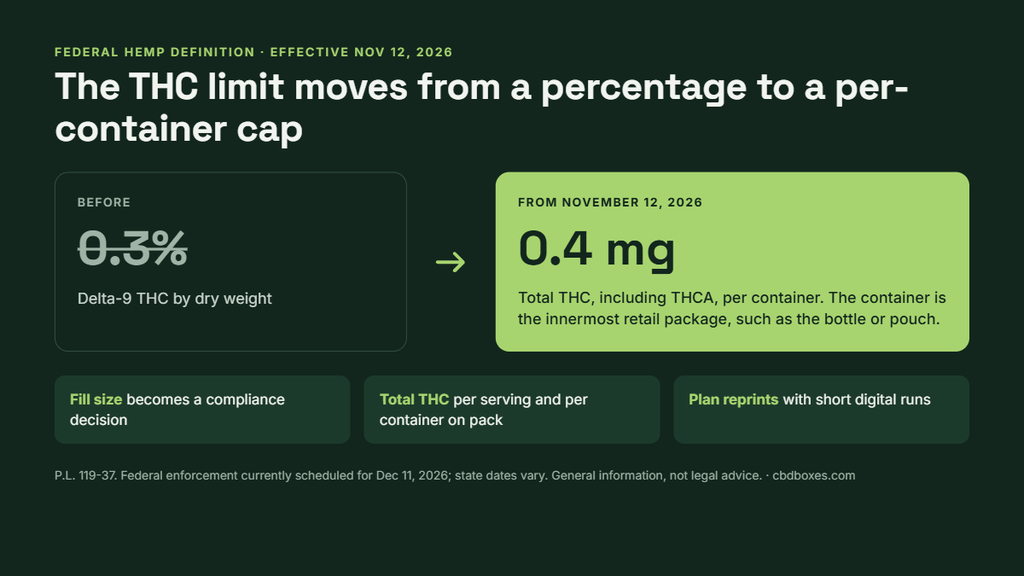
This is the biggest packaging change for CBD brands since 2018, and most guides haven’t caught up yet.
On November 12, 2026, the federal definition of hemp changes under P.L. 119-37. A finished hemp-derived product may contain no more than 0.4 mg of total THC, including THCA, per container. The law treats the container as the innermost package that holds the product for retail sale, such as the bottle or pouch. The old 0.3% delta-9 dry-weight test no longer decides whether a finished product counts as hemp.
Timing may differ by state. The Illinois Department of Revenue notes that federal enforcement is currently scheduled for December 11, 2026, while Illinois enforces its own rules from November 12.
Here is what that means in practice for your packaging:
- Fill size is now a compliance decision. Because the cap is per container, the amount of product in each unit can decide its legal status. Settle formulation and fill size with your lab and counsel before you approve a dieline.
- Total THC needs to be clear on pack. Expect retailers and distributors to ask for total THC per serving and per container.
- Plan for reprints. Brands reformulating full-spectrum products will need new artwork. Short digital runs help you avoid a warehouse of obsolete cartons.
- Some products may change channel. Products above the cap stop being hemp and fall under state cannabis rules, which have stricter packaging requirements.
What has to be printed on a CBD box?
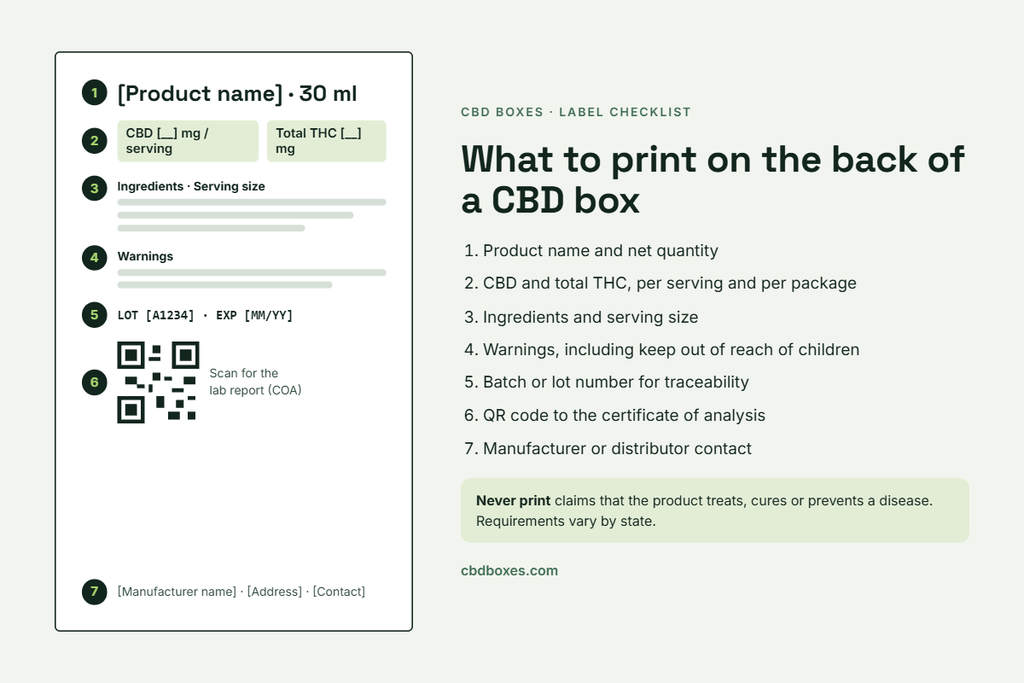
Requirements vary by state, but most CBD boxes need to show:
- Product name and net quantity
- CBD per serving and per package, in mg
- Total THC per serving and per package
- Ingredients and serving size
- A batch or lot number for traceability
- A QR code or link to the certificate of analysis
- The manufacturer or distributor’s name and contact details
- Warnings, such as keep out of reach of children, pregnancy advice and an FDA disclaimer
Leave out any claim that the product treats, cures or prevents a disease.
To give one real example, Virginia requires child-resistant packaging for hemp extracts containing THC, an English label in type at least 1/16 inch high listing ingredients and serving size, and a unique batch code.
Are CBD boxes child-resistant?
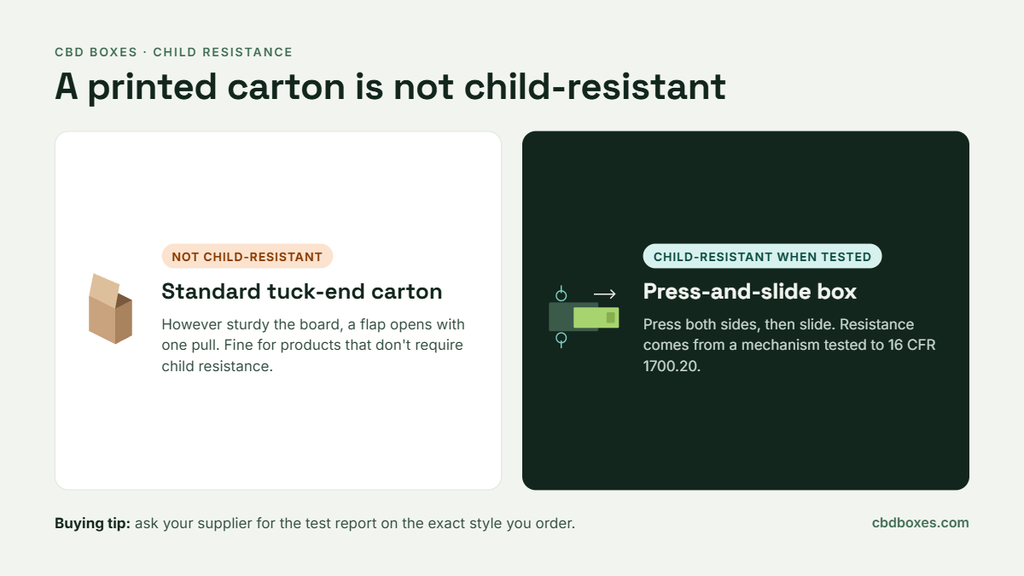
Not on their own. This is one of the most common misunderstandings we hear.
A standard printed carton, however sturdy, is not child-resistant. Child resistance comes from a tested mechanism, such as a press-and-slide drawer, a locking tray or a child-resistant cap on the bottle. Those mechanisms are tested against the protocol in 16 CFR 1700.20. If your state or retailer requires child-resistant packaging, ask your supplier for the test report on the exact style you are buying, and keep it on file. You can see the styles we make in our child-resistant boxes range.
Artwork counts too. Many states ban packaging that appeals to children, so avoid cartoon characters, candy-style illustrations and lettering that imitates snack brands.
How much do Custom CBD boxes cost?
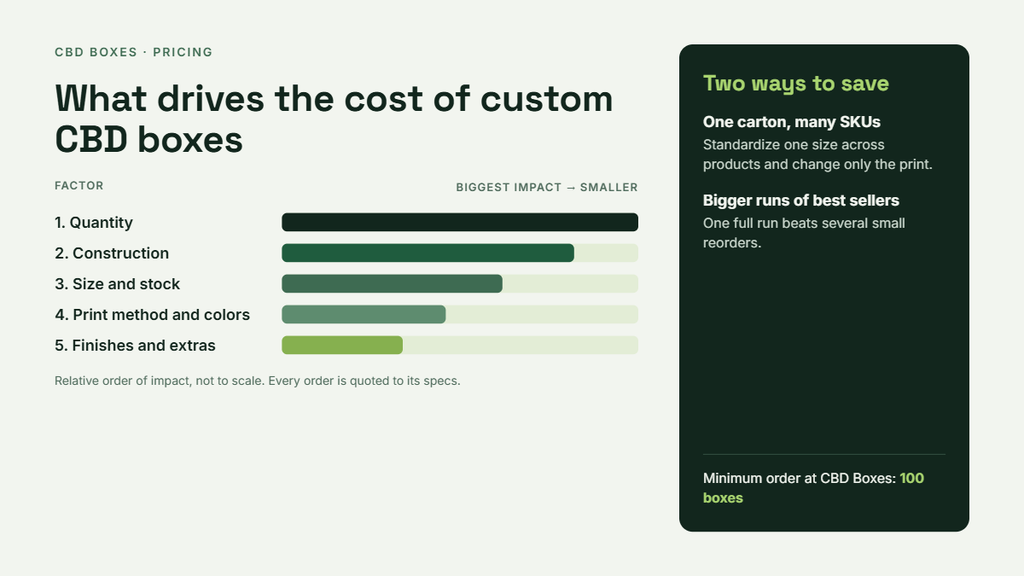
There is no single price, because custom CBD boxes are quoted to your specs. What you can control is what drives the number. In rough order of impact:
- Quantity. Setup costs are spread across the run, so the price per box drops sharply as volume rises.
- Construction. A rigid or child-resistant box can cost several times as much as a simple tuck-end carton.
- Size and stock. Larger boxes and heavier boards use more material.
- Print method and colors. Digital suits short runs; offset with Pantone colors suits long ones.
- Finishes and extras. Foil, embossing, windows and inserts each add a production step.
Two easy ways to save: standardize one carton size across several products and change only the print, and order a full run of your best seller rather than several small reorders.
On minimums, most custom suppliers start somewhere between 100 and 1,000 units. At CBD Boxes the minimum is 100, which makes a first retail run realistic for a new brand.
How to order CBD boxes without the usual headaches?
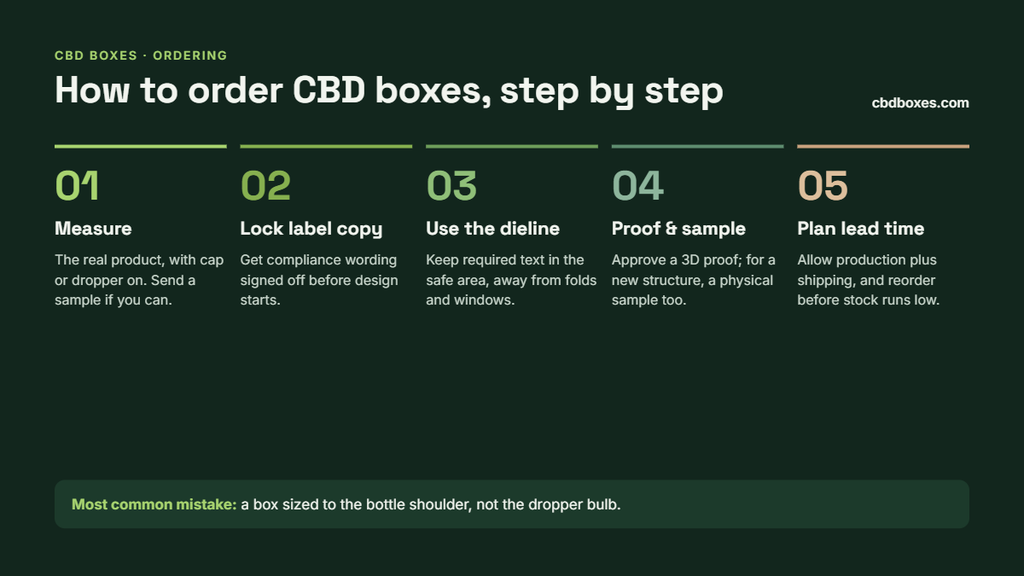
- Measure the real product, with the cap, dropper or pump attached. If you can, send a sample.
- Finalize your label copy first. Get compliance wording signed off before the designer starts.
- Design on the supplier’s dieline. Keep required text inside the safe area and away from folds, glue flaps and windows.
- Approve a 3D proof, and for a new structure, a physical sample. It is far cheaper to fix a sample than a full run.
- Plan your lead time. Allow for production after proof approval plus shipping, and reorder before stock runs low.
Five CBD packaging mistakes we see every month
- A box sized to the bottle, not the dropper. The lid won’t close, or the bulb gets crushed.
- Required text running over a fold. It cracks, smudges or becomes unreadable.
- Kraft chosen for bright, colorful artwork. The brown base mutes everything unless white ink goes down first.
- Assuming a carton is child-resistant. Without a tested mechanism, it isn’t.
- Ordering a year’s supply before a rule change. With the November 2026 hemp rules arriving, smaller runs are the safer bet.
Can CBD boxes be eco-friendly?
Yes, and most CBD buyers expect it. Kraft and recycled paperboard, soy- or water-based inks and paper inserts all help. The details matter, though. Full plastic lamination and foam inserts can make a box harder to recycle, so if recyclability is part of your brand story, choose an aqueous coating and paper inserts instead.
Frequently asked questions
What are CBD boxes used for?
CBD boxes protect CBD products from light and damage, carry required label information such as cannabinoid content, batch numbers and warnings, and present the brand on shelf and online.
Why choose custom CBD boxes over stock boxes?
Custom CBD boxes fit the product exactly, give you full panels for required information and carry your branding across every surface. Stock boxes are cheaper for samples but rarely suit retail.
What is the best material for CBD boxes?
SBS paperboard at 16–18 pt suits most tinctures, vapes and topicals because it prints sharply. Kraft suits natural brands, corrugated suits shipping and displays, and rigid board suits gift sets.
Do CBD boxes need to be child-resistant?
It depends on the product and the state. Many states require it for products containing THC, edibles and vapes. A standard carton is not child-resistant; you need a tested mechanism such as a press-and-slide box.
Does the 0.4 mg THC rule apply to the box?
No, it applies to the product, measured per container. The law treats the container as the innermost package holding the product for retail sale, such as the bottle or pouch.
What is the minimum order for custom CBD boxes?
It varies by supplier. CBD Boxes produces custom CBD boxes from 100 units, and digital printing keeps short runs affordable.
The bottom line
Good CBD boxes are not just pretty cartons. They fit the product exactly, carry every required line of text clearly, and hold up from the warehouse to the customer’s hands. With the federal hemp rules changing on November 12, 2026, now is a good time to review your packaging, check your label content and plan any reprints.
If you would like a second pair of eyes on your packaging, our team is happy to help. You can explore our custom CBD boxes or request a quote.
This article is general information, not legal advice. Please confirm the requirements for your product and state with qualified counsel.
Sources: DLA Piper on P.L. 119-37 · Illinois Department of Revenue, FY 2027-04 · Code of Virginia § 3.2-5145.4:1