
In a dispensary cooler packed with jars, pouches, and cartridges that all look alike, your label is the fastest way a customer decides what to reach for. But cannabis isn’t like any other product on a shelf. Every custom cannabis label has to sell and satisfy a strict, constantly shifting set of regulations at the same time. Get the balance right and you build a brand people remember. Get it wrong and you risk fines, recalls, or products pulled from the display entirely.
This guide breaks down what goes into custom marijuana labels that are both compliant and commercial: the required elements, the material and printing choices, and the design decisions that separate a forgettable sticker from a genuine brand asset.
Why Custom Cannabis Labels Are Different
Most product labels have one job: look good and say what’s inside. Cannabis labels carry a heavier load. They act as a legal document, a safety notice, and a marketing tool all at once, usually printed on a surface that’s small, curved, and headed into humid, cold, or high-friction environments.
That’s why generic sticker printing rarely works. A custom cannabis label is engineered around the container it lives on (a jar, mylar bag, tincture bottle, vape cartridge, or pre-roll tube), the way the product is stored, and the specific disclosures your state demands. When those three factors drive the design, you get a label that survives handling and passes inspection instead of one that peels off in a cold case or fails a compliance check.
What Every Compliant Cannabis Label Needs
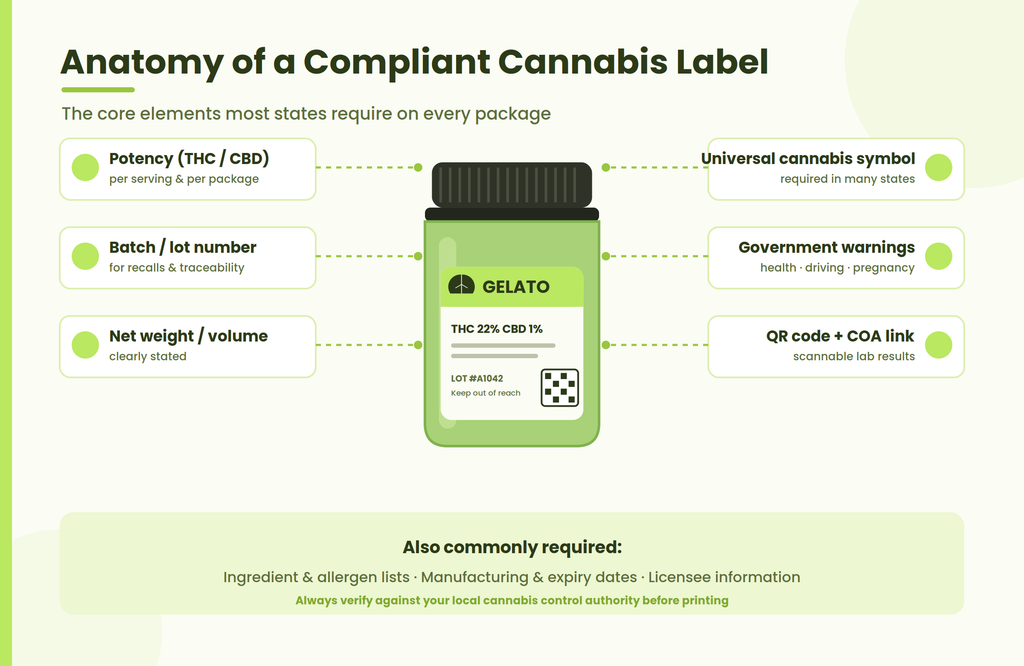
Requirements vary significantly by state and country, so always verify against your local cannabis control authority before you print. That said, most jurisdictions expect cannabis packaging labels to carry a consistent core set of elements:
- Potency information, including THC and CBD content per serving and per package
- Net weight or volume of the product
- Batch or lot number for traceability and recalls
- The universal THC or cannabis symbol required in many markets
- Government warnings covering health, driving, pregnancy, and keeping the product away from children
- Ingredient and allergen lists, plus any added terpenes or solvents
- Manufacturing and expiration or packaged-on dates
- Licensee information and the producing facility
- QR codes or scannable test data linking to a Certificate of Analysis
Because these elements are non-negotiable, smart brands design the label so the compliance text stays legible without swallowing the artwork, often using a dedicated panel or the back of a two-part peel-and-reseal label. Dispensary labels applied in-store for individual orders follow the same logic: the regulated data has a fixed home, and the branding gets its own protected space.
Strain Labels, Stickers, and Templates
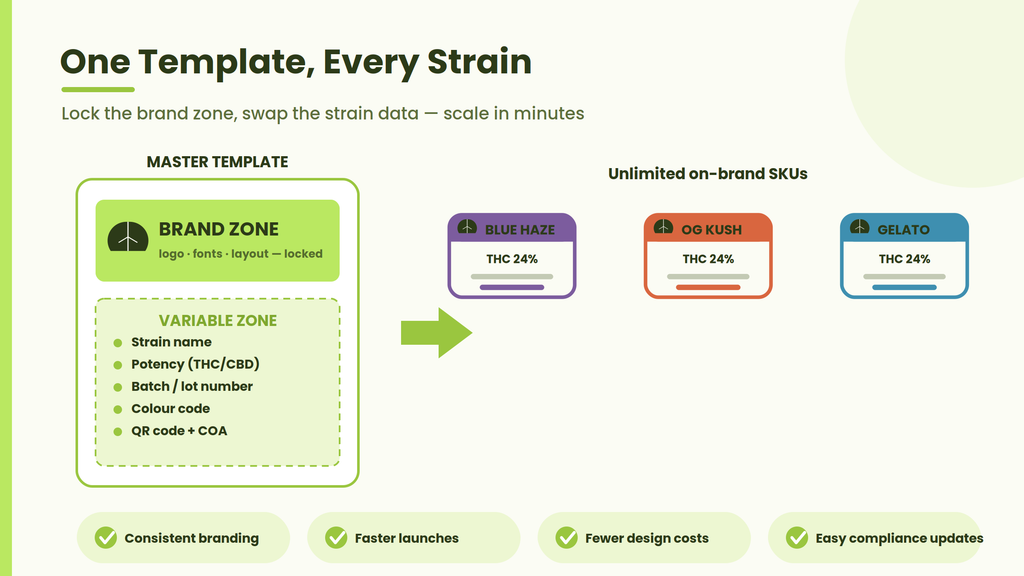
For multi-strain producers, strain label stickers are where branding really goes to work. A well-built strain label template keeps your brand system consistent, using the same logo placement, fonts, and layout, while swapping the strain name, potency, and color coding for each SKU. This lets you launch a new strain in minutes instead of redesigning from scratch, and it helps budtenders and customers instantly recognize your lineup across a crowded menu.
If you’re searching for a cannabis label template, look for one that clearly separates the fixed brand zone from the variable strain-data zone. That structure is what makes scaling across dozens of strains manageable, and it’s exactly how experienced label designers build systems for growing brands rather than one-off files.
Materials and Finishes That Hold Up
A cannabis label has to survive its environment. The right material choice prevents the peeling, smudging, and fading that make a premium product look cheap:
- Waterproof and oil-resistant stocks for concentrates, tinctures, and topicals
- Freezer-grade adhesives for products stored cold
- Matte, gloss, or soft-touch laminates that protect the print and set a tone, with soft-touch reading as especially premium
- Specialty finishes like foil stamping, spot UV, and embossing to signal quality and justify a higher price point
- Clear “no-label look” stock for a minimalist, high-end aesthetic on glass
- Recyclable and compostable materials for eco-conscious shoppers, increasingly a real purchase driver
The finish you choose does more than protect the ink. It tells the customer what tier your product sits in before they’ve read a single word, which is why premium brands treat material as part of the design rather than an afterthought.
Cannabis Label Printing: Your Options
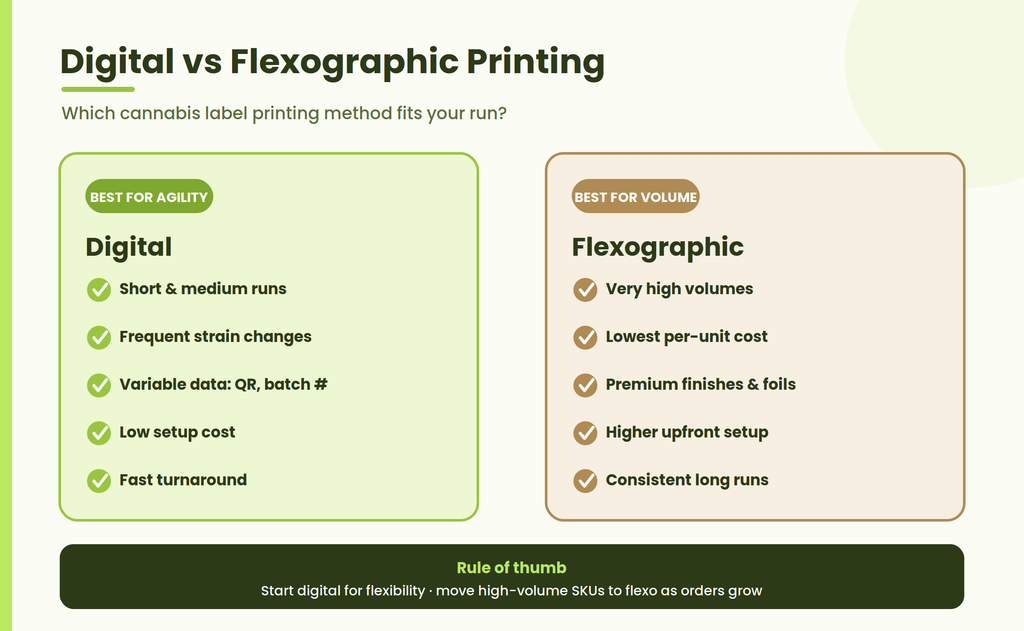
Cannabis label printing generally comes down to two routes. Digital printing is ideal for shorter runs, frequent strain changes, and variable data like unique batch numbers or QR codes, with low setup costs and fast turnaround. Flexographic printing wins on very large volumes, offering a lower per-unit cost and premium finish options, though it carries higher upfront setup.
Growing brands often start with digital for its flexibility, then move high-volume SKUs to flexo as order sizes climb. The right choice depends on your run length, your number of strains, and how often your compliance text changes. If your state updates its warning requirements regularly, digital’s low reprint cost can save you from throwing out plates and inventory every time the rules shift.
Balancing “Custom Labels Cheap” With Compliance
It’s tempting to chase the lowest price, and searches for custom labels cheap are common for a reason: margins matter in a heavily taxed industry. But in cannabis, the cheapest label can become the most expensive mistake if it fails a compliance check or peels off in a cold display. The smarter play is to lower cost without cutting corners:
- Order in bulk or wholesale to drop the per-unit price
- Standardize a template system so design is a one-time cost, not a per-strain one
- Consolidate SKUs onto shared material and finish specifications
- Use digital printing to avoid plate fees on smaller runs
That way you protect your margin and your license at the same time.
Frequently Asked Questions
What information is legally required on a cannabis label?
It varies by state, but most require potency, net weight, batch number, the universal cannabis symbol, government health warnings, ingredients, dates, license information, and a scannable link to lab results. Always confirm with your local regulator first.
What’s the best material for cannabis labels?
For most products, a waterproof, oil-resistant stock with a protective laminate. Cold-stored items need freezer-grade adhesive, and glass jars often use clear film for a premium, no-label look.
Can I use one template for multiple strains?
Yes. A strain label template with a fixed brand zone and a variable data zone lets you roll out new strains quickly while keeping branding consistent and compliant.
Final Thoughts
Custom cannabis and marijuana labels sit at the intersection of law and branding. They have to protect your license and win the shelf in the same square inch of space. The brands that get this right treat labeling as a system: compliant by design, built on reusable strain templates, printed on materials that survive real-world conditions, and finished in a way that signals quality the moment a customer picks it up.