
Custom boxes are packaging built to your exact size, material, and print engineered around one product and branded for one company, instead of a generic box you force your product to fit. For small businesses, that shift is one of the highest-return moves in packaging: the box is often the first physical thing a customer touches, and it does the work of a silent salesperson every time an order arrives.
This is a practical, buyer-focused walkthrough for small business owners, packaging designers, and marketers. We’ll cover what custom boxes are and why they matter, how to choose the right custom size boxes, the materials behind box printing, how custom boxes with logo strengthen your brand, and how to find cheap custom boxes without gambling on quality. We manufacture custom packaging in the USA (out of Sacramento, CA), so where it helps we’ve added the real-world benchmarks minimums, turnaround, and pricing that actually affect your order.
Introduction to Custom Boxes
What are Custom Boxes?
A custom box is packaging made to order: your dimensions, your material, your structure, and your artwork. That’s the difference between a plain brown carton and a branded custom printed box that reinforces who you are the moment it lands on a doorstep or a store shelf.
Custom boxes matter because packaging is now a buying signal, not an afterthought. A majority of consumers say packaging design influences what they buy, and distinctive packaging measurably improves a brand’s odds of winning and keeping a customer. For a small business fighting for attention, that’s leverage you can’t get from a stock box.
Types of Custom Boxes
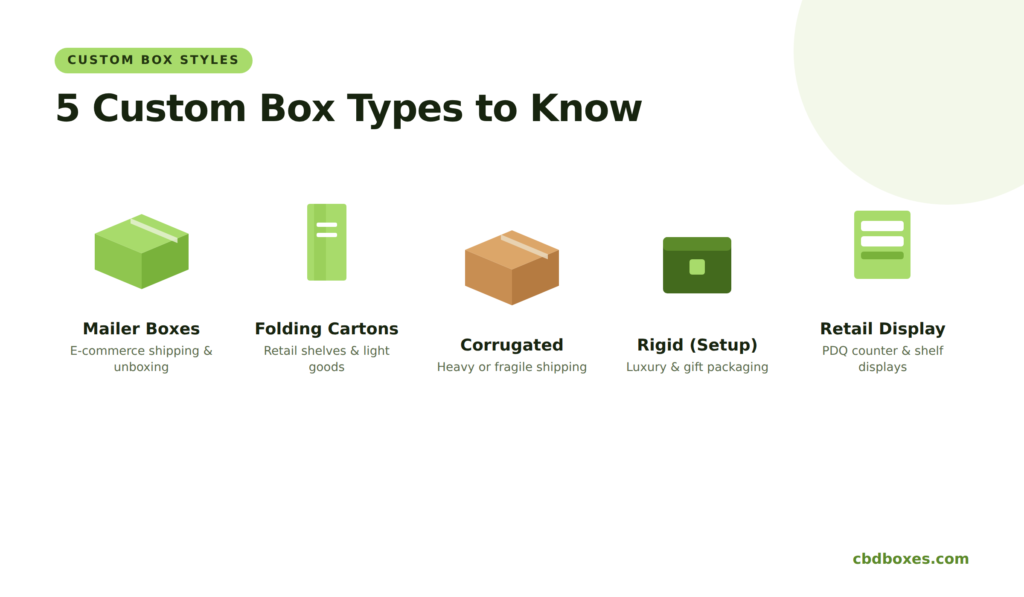
Most orders fall into a handful of workhorse formats:
- Mailer boxes self-locking corrugated boxes built for e-commerce shipping and the unboxing moment.
- Folding cartons (tuck-end boxes) lightweight printed cardboard boxes for retail shelves: cosmetics, supplements, foods, and CBD cartons.
- Custom corrugated boxes durable fluted board for shipping heavier or fragile goods.
- Rigid (setup) boxes premium, non-collapsible boxes for luxury and gift items.
- Custom retail packaging boxes designed to display and sell in-store, not just protect.
Benefits of Custom Printed Boxes
The payoff for using custom printed boxes is concrete: stronger brand recognition and recall, a better unboxing experience that drives repeat orders and social sharing, a right-sized fit that lowers shipping costs and reduces damage, and packaging that can be made recyclable and eco-friendly to match customer expectations. In short, a custom box protects the product and markets the brand at the same time one cost, two jobs.
Choosing the Right Custom Size Boxes
Ordering custom size boxes is the step small businesses most often get wrong, and it quietly costs money on every shipment. Too big, and you pay for air (dimensional-weight freight) plus extra void fill and higher damage rates; too small, and the product won’t fit or gets crushed.
Factors to consider for sizing
Size the box around three things: the product’s dimensions plus a small tolerance, the protection it needs (fragile items need room for cushioning), and how it ships or displays (mailer, shelf carton, or retail display). Also weigh flat-shipping and storage boxes that ship and store flat to save space and money.
How to Measure Products for Custom Boxes
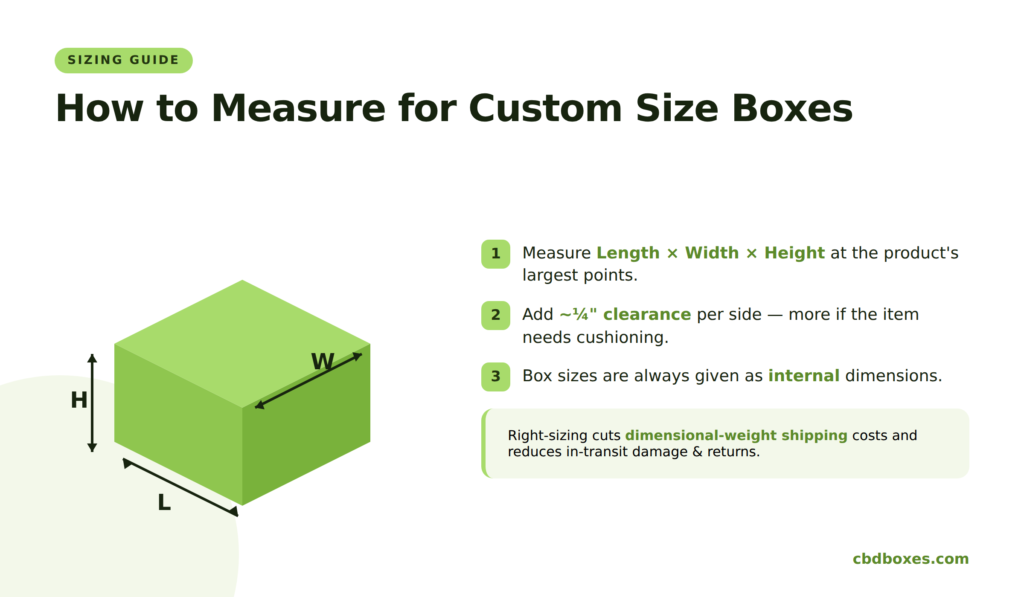
Measure the product’s length × width × height at its largest points, then add clearance typically about a quarter-inch per dimension for a snug retail carton, and more when you need cushioning inside a shipper. Box dimensions are always given as internal length × width × height, so you’re specifying the space the product will actually occupy. When in doubt, order a physical sample or a dieline proof before committing to a full run.
Examples of Custom Size Boxes by Product
A subscription brand might use a right-sized mailer so products don’t shift in transit; a supplement or CBD brand uses a slim folding carton sized to the bottle with room for a leaflet; a candle or ceramics seller uses a corrugated shipper with a fitted insert. The through-line: the box is engineered to the product, which is exactly what a stock box can’t do.
Materials Used in Box Printing
Material is where protection, print quality, and cost all meet. Getting box printing right starts with choosing the right stock for the job.
Common Materials for Custom Boxes
The three you’ll choose between most often are cardstock (folding carton board) for lightweight retail boxes, corrugated board for shipping strength, and rigid board for premium presentation. Natural kraft is a popular eco-forward option across all three looks.
Benefits of Custom Corrugated Boxes
Custom corrugated boxes are the default for shipping because the fluted inner layer absorbs shocks and stacking pressure while staying lightweight and you get real protection without heavy freight costs. They’re also highly printable and widely recyclable, which is why corrugated dominates e-commerce packaging.
Comparing Printed Cardboard Boxes and other Materials
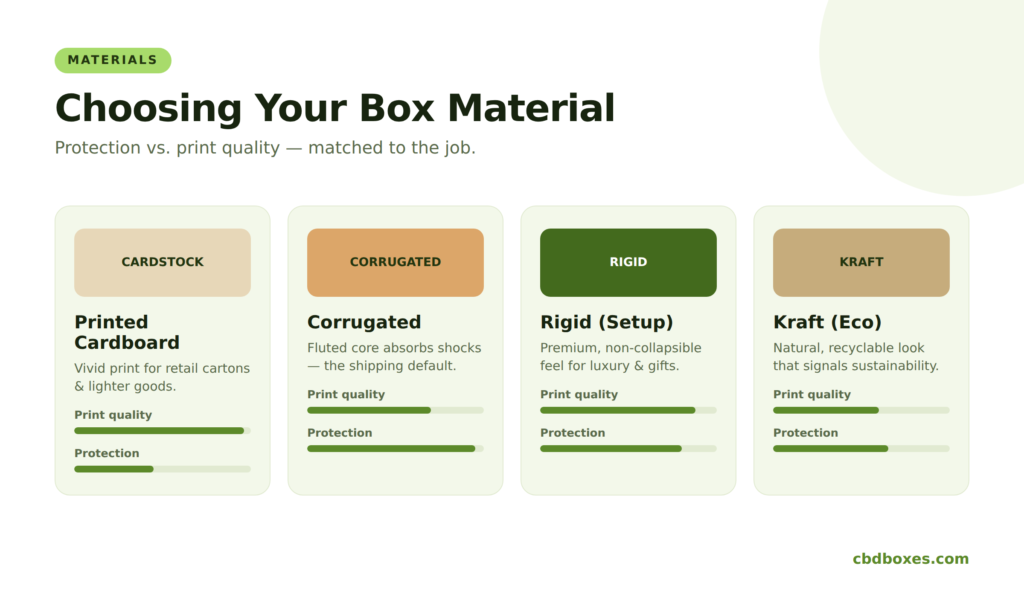
Printed cardboard boxes (folding cartons) give you the smoothest, most vivid print surface, making them ideal for retail shelves where color and finish sell the product but they offer less crush protection than corrugated, so they’re best for lighter goods or as retail cartons inside a shipper. Rigid boxes deliver the most premium feel at the highest cost. A common, cost-smart setup for small businesses is a printed cardboard retail carton shipped inside a plain or lightly branded corrugated mailer, so you pay for premium print only where the customer sees it.
Across every material, printing box options include full-color CMYK for artwork, Pantone (PMS) spot colors for exact brand-color matching, and finishes like matte or gloss lamination, soft-touch, spot UV, foil stamping, and embossing or debossing to add perceived value.
Enhancing Your Brand with Custom Boxes
Packaging is one of the cheapest brand-building tools a small business has, because you’re already paying to ship something you might as well ship your brand.
How Custom Boxes with Logo Improve Branding
Custom boxes with logo turn every shipment into a brand impression. A consistent logo, color, and typography across your packaging builds recognition over repeat orders, signals professionalism and trust to a first-time buyer, and creates the kind of shareable unboxing moment that fuels organic social reach. For a small brand, that repeated, consistent exposure is how you start to feel “bigger” than you are.
What great Branded Packaging Looks like
The custom-packaged brands that win tend to do the same simple things well: they keep the design consistent with the rest of their identity, choose one or two finishes that suit the product rather than piling on every option, and use the inside of the box (printed interiors, thank-you messages, insert cards) to extend the experience. The goal isn’t the flashiest box, it’s the most unmistakably yours box.
Tips for Designing Eye-Catching Custom Retail Packaging Boxes
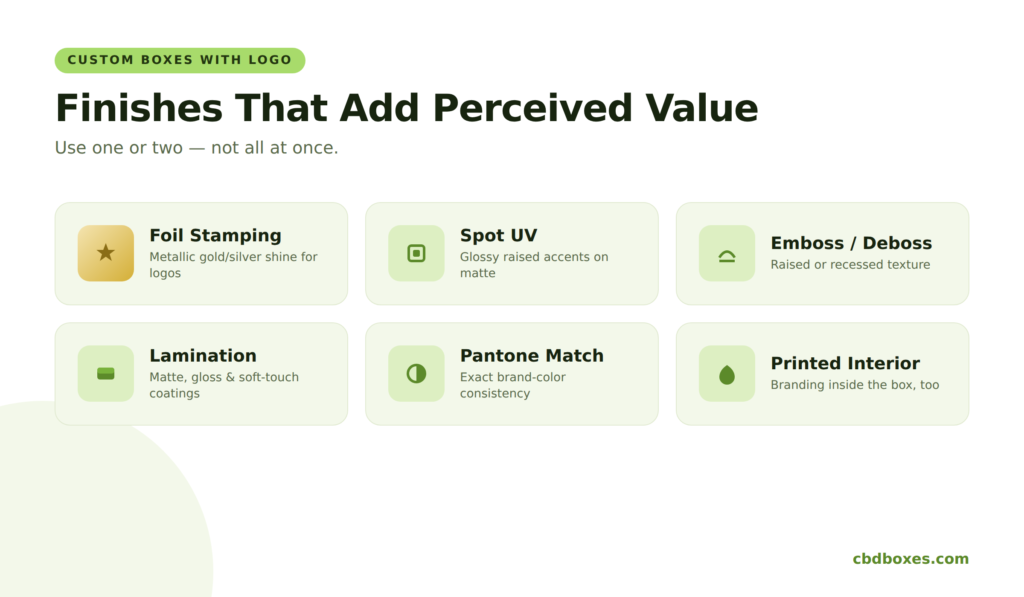
For custom retail packaging boxes that have to sell on a crowded shelf: lead with one clear focal point and legible branding readable from a few feet away; keep critical artwork and text at least an eighth of an inch inside cut and fold lines so nothing gets trimmed; use finish to create contrast (a spot-UV logo on a matte box, for example); and always approve a physical proof or 3D mockup before the full run. For regulated products like CBD and cannabis, design around compliance from the start child-resistant structure and accurate labeling space are requirements, not add-ons.
Finding Affordable Custom Boxes
You don’t have to choose between custom and affordable. Digital and on-demand printing have lowered minimums and setup costs, so cheap custom boxes meaning genuinely low cost per unit, not low quality are within reach for small runs.
Where to buy Custom Boxes for Small Business
Look for a manufacturer (not a broker) that openly supports custom boxes for small business: reasonable minimums (around 100 units is standard; some products start much lower), free design/dieline support, and transparent pricing. A U.S.-based maker generally means faster turnaround, easier communication, simpler reorders, and no surprise import duties in your landed cost.
Comparing Prices and Quality of Box Printing Services
The cheapest quote is rarely the cheapest order. When you compare box printing services, weigh print and color accuracy (does the final match the proof?), structural quality and fit, honest turnaround, and real proofing and support the things that prevent costly reprints. Read the 3-star reviews, not just the 5-star ones, to find the real trade-offs. As a reference point, our own team ships free across the USA with roughly 8–10 business-day turnaround and serves 5,000+ customers at a 4.9 rating.
Budget-Friendly Packaging Tips for Small Businesses
Stretch your packaging budget by ordering in the largest quantity you can realistically use (per-unit cost drops sharply with volume often up to about 50% off at 5,000+ units), right-sizing boxes to cut shipping costs, limiting yourself to one or two finishes, and putting premium print only where customers see it. Standardizing on one or two box sizes across your product line also lowers cost and simplifies fulfillment.
Frequently Asked Questions
What are custom boxes and their benefits?
Custom boxes are packaging made to your exact size, material, and print. The benefits: stronger brand recognition, a better unboxing experience, right-sized fit that lowers shipping costs and damage, and the option for recyclable, eco-friendly materials protection and marketing in one.
How do I choose the right custom size boxes?
Measure your product’s length × width × height at its largest points, add clearance (about a quarter-inch for a snug retail carton, more for cushioning), and factor in how the box ships or displays. Order a sample or dieline proof before a full run.
What materials are used in box printing?
The most common are cardstock (folding carton board) for retail boxes, corrugated board for shipping strength, and rigid board for premium presentation with kraft as a popular eco-friendly option. Print uses CMYK or Pantone colors plus finishes like lamination, spot UV, foil, and embossing.
How can custom boxes enhance my branding?
Custom boxes with your logo turn every shipment into a brand impression, build recognition through consistent design, signal professionalism to new buyers, and create shareable unboxing moments of repeated, low-cost brand exposure that makes a small business look established.
Where can small businesses find cheap custom boxes?
Choose a U.S. manufacturer that supports small businesses with low minimums (around 100 units, some far lower), free design support, and transparent, volume-based pricing. Order the largest quantity you’ll realistically use and right-size your boxes to keep both unit and shipping costs down.
Ready to Order Custom Boxes for Your Brand?
Whether you need custom printed retail cartons, sturdy corrugated shippers, or child-resistant CBD packaging, the essentials are the same: right size, right material, and a design that earns the sale. Our USA-based team can send you a free dieline template and 3D proof for your product 100-unit minimums, roughly 8–10 business-day turnaround, and free U.S. shipping. Request a quote and get your custom boxes moving.