
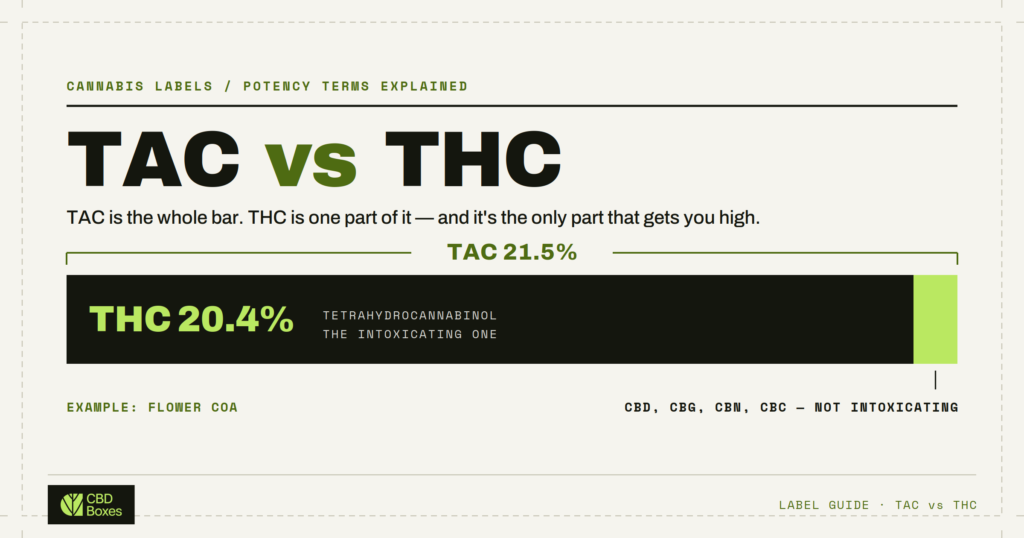
THC is a single cannabinoid. TAC — Total Active Cannabinoids is the sum of every active cannabinoid in the product, THC included. TAC is therefore always the higher of the two numbers on a label. A higher TAC does not mean a stronger high, because only the THC portion is intoxicating.
What Does THC Mean on a Label?
THC stands for tetrahydrocannabinol, the cannabinoid responsible for the intoxicating effects of cannabis.
The number printed on a label is usually Total THC, not delta-9 THC alone. That distinction matters more than most shoppers realize. Raw flower contains very little active delta-9 THC almost all of it exists as THCA, the acid precursor, which isn’t intoxicating until heat converts it.
The industry-standard formula for Total THC is:
Total THC = Δ9-THC + (THCA × 0.877)
The 0.877 factor accounts for the mass the molecule loses during decarboxylation, when THCA sheds a carbon dioxide group and becomes THC. Skip that conversion and you overstate potency; that’s why the factor is standard in regulated markets.
What Does TAC Mean on a Label?
TAC stands for Total Active Cannabinoids. It’s the sum of all the cannabinoids a lab detected in the sample THC plus CBD, CBG, CBN, CBC, THCV and any other minor cannabinoids present in measurable amounts.
TAC tells you how cannabinoid-dense a product is overall. It does not tell you how intoxicating it is.
TAC vs THC at a glance
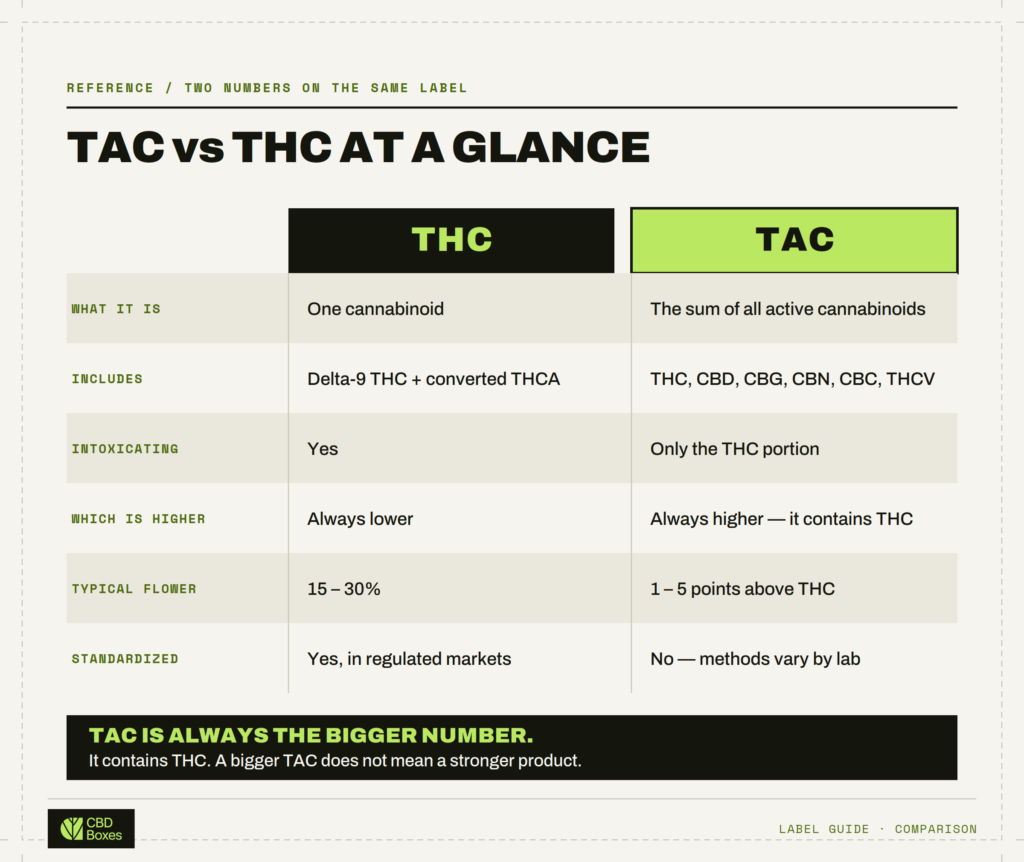
| What it is | One cannabinoid | The sum of all active cannabinoids |
| Includes | Δ9-THC + converted THCA | THC, CBD, CBG, CBN, CBC, THCV and others |
| Intoxicating? | Yes | Only the THC portion is |
| Which is higher? | Always lower | Always higher it contains THC |
| Typical flower value | 15–30% | 1–5 points above the THC figure |
| Standardized? | Yes, in regulated markets | No |
Worked Example: Reading a Real COA
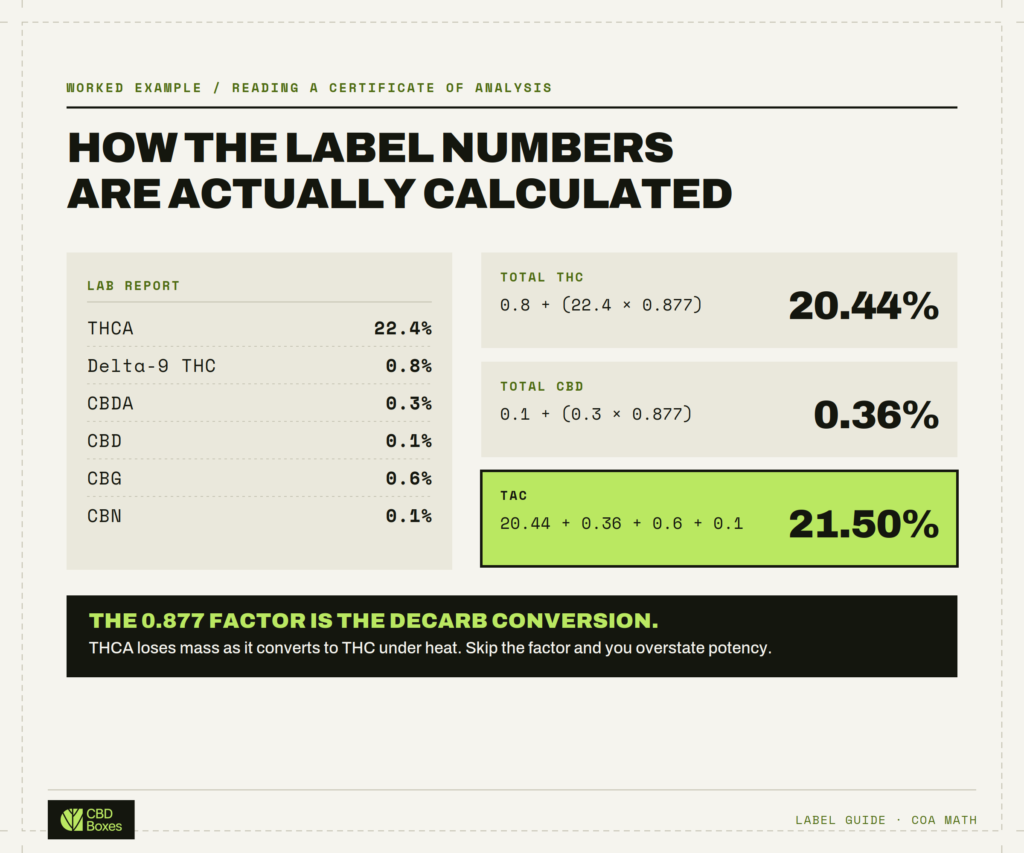
Take a flower certificate of analysis showing:
| Cannabinoid | Result |
|---|---|
| THCA | 22.4% |
| Δ9-THC | 0.8% |
| CBDA | 0.3% |
| CBD | 0.1% |
| CBG | 0.6% |
| CBN | 0.1% |
Total THC = 0.8 + (22.4 × 0.877) = 20.44% Total CBD = 0.1 + (0.3 × 0.877) = 0.36% TAC = 20.44 + 0.36 + 0.6 + 0.1 = 21.50%
So the label reads roughly TAC 21.5% / THC 20.4% about one percentage point apart. On typical THC-dominant flower, that small gap is normal.
Now take a balanced 1:1 product: 9.8% THC, 10.2% CBD, 0.5% minor cannabinoids. TAC is 20.5% while THC is 9.8% — TAC is more than double. Same math, completely different relationship, because the cannabinoid mix is different.
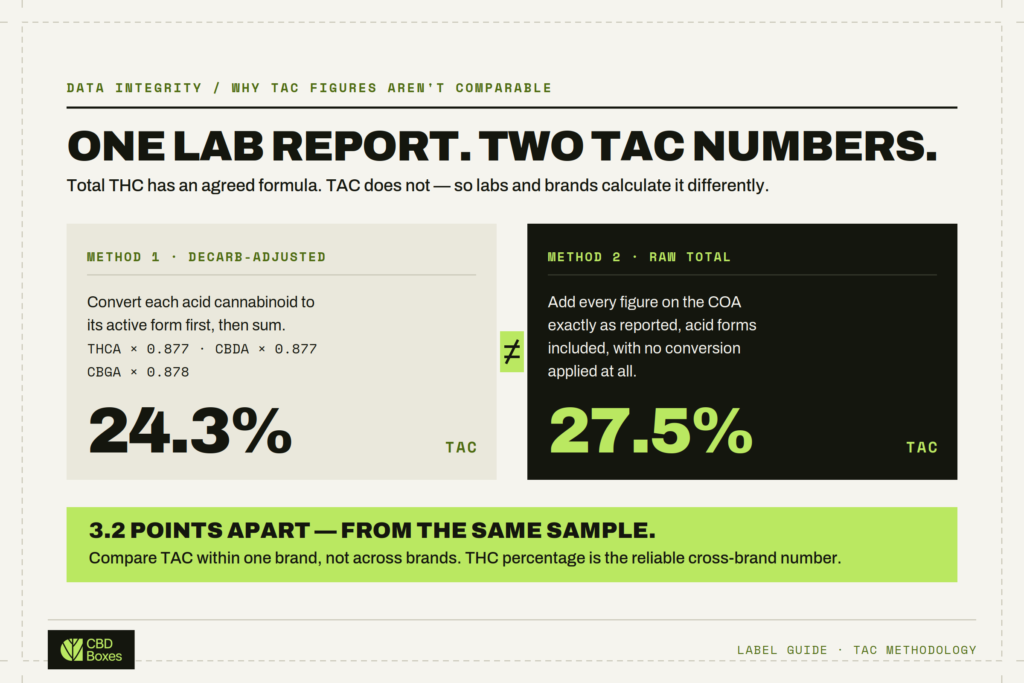
That’s the practical lesson: the gap between TAC and THC tells you what kind of product you’re holding. A narrow gap means THC-dominant. A wide gap means significant CBD or minor cannabinoid content.