
If you sell CBD in the United States, your packaging is no longer just a container; it is a legal document. And on November 12, 2026, the single most important number on that document changes.
This guide explains what federal and state law require on CBD boxes right now, what the new federal hemp definition does to your labels and your fill volumes, and how to design custom CBD packaging that survives the transition without a full reprint.
Quick answer: CBD packaging in the U.S. must carry accurate potency, net quantity, ingredients, a batch or lot number, a “keep out of reach of children” warning, manufacturer details, and no disease or treatment claims. Cannabis and THC products carry a heavier load: child-resistant construction, opaque and tamper-evident materials, a state universal THC symbol, and state-mandated warning text. From November 12, 2026, finished hemp-derived cannabinoid products face a federal cap of 0.4 mg total THC per container.
What are CBD packaging regulations?
CBD packaging regulations are the federal and state rules governing how hemp-derived CBD products are contained, labeled, and marketed. They come from four separate layers, and most compliance failures happen because a brand satisfies one layer and forgets the other three.
- The Federal Food, Drug, and Cosmetic Act (FD&C Act) — governs labeling accuracy, ingredient disclosure, and health claims. Misbranding is a federal offense.
- The Agricultural Marketing Act, as amended by P.L. 119-37 § 781 — defines what legally counts as “hemp,” including new THC limits measured per container.
- The Poison Prevention Packaging Act (PPPA), 16 CFR § 1700 — the child-resistance baseline every state cannabis program builds on.
- State law — where the real complexity lives. Symbols, warning text, font sizes, opacity, plain-packaging rules, and extended producer responsibility all vary by jurisdiction.
What changes for CBD packaging on November 12, 2026?
This is the question every brand should be asking, and most are still not asking it.
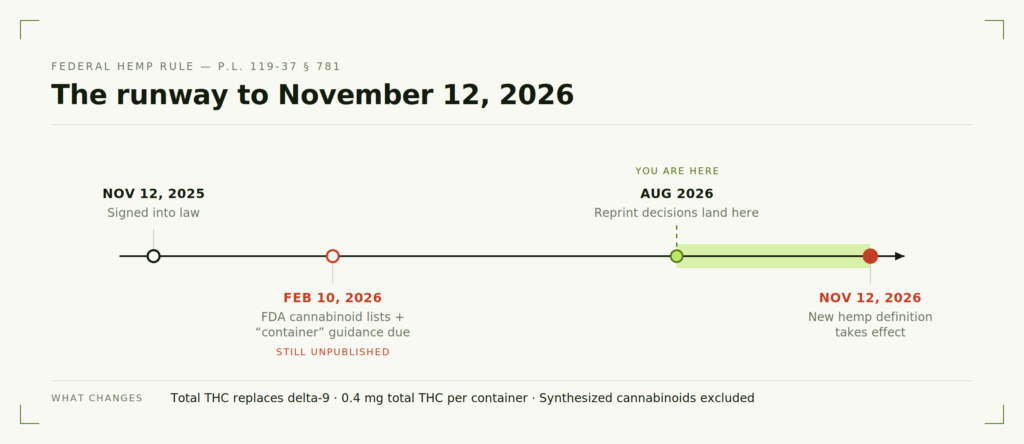
On November 12, 2025, Congress enacted P.L. 119-37. Buried in Section 781 of Division B is a rewrite of the federal definition of hemp. It was signed with a deliberate one-year runway, so it takes effect November 12, 2026. Until that date, the 2018 Farm Bill standard still governs federally.
Three changes matter for anyone printing packaging:
1. Total THC replaces delta-9 THC as the standard
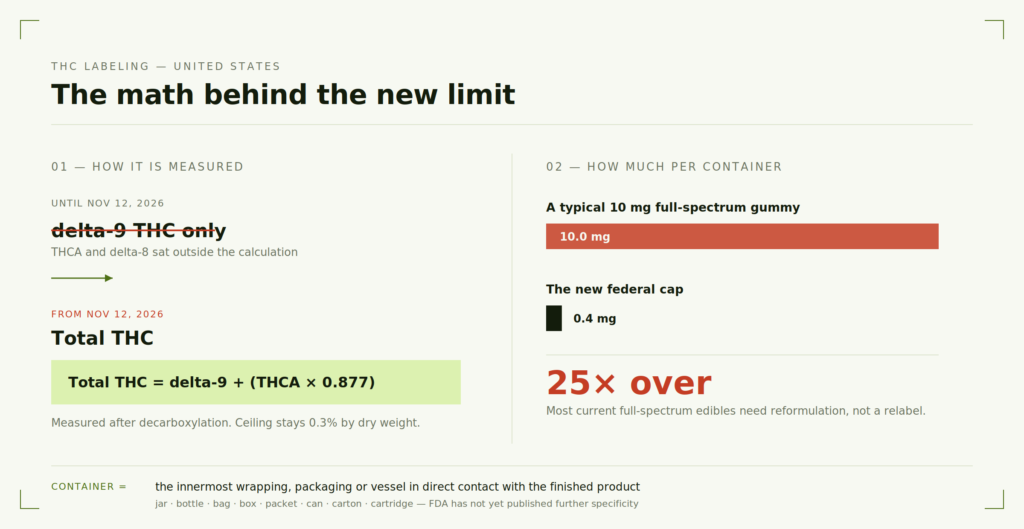
The old test looked only at delta-9 THC at 0.3% by dry weight. The new test measures total THC, calculated after decarboxylation and inclusive of THCA and delta-8. In practice: total THC = delta-9 + (THCA × 0.877).
If your label copy, your COA landing page, or your marketing says “compliant hemp, under 0.3% delta-9,” that phrasing has an expiry date.
2. A 0.4 mg total THC cap per container
Finished hemp-derived cannabinoid products are capped at 0.4 milligrams of total THC per container. For context, a common 10 mg full-spectrum gummy sits at roughly 25 times that limit. Most full-spectrum edibles, beverages, and tinctures on shelves today will require reformulation, relabeling, or both.
3. Synthesized and converted cannabinoids are excluded
Cannabinoids produced through chemical synthesis or conversion outside the Cannabis sativa L. plant fall outside the new hemp definition entirely. Delta-8, HHC, and THC-O product lines are directly affected.
Because the Controlled Substances Act defines hemp by cross-reference, products that fall outside the narrowed definition revert to Schedule I treatment federally once the change takes effect.
What counts as a “container” under the new 0.4 mg limit?
This is the detail that should be driving your packaging decisions, and it is genuinely good news for anyone selling in printed boxes.
The statute defines a container as the innermost wrapping, packaging, or vessel in direct contact with the finished product; a jar, bottle, bag, box, packet, can, carton, or cartridge.
The practical reading: the limit attaches to the primary container touching the product, not necessarily to the outer retail carton that holds it. A printed CBD box that houses a sealed inner pouch or bottle is performing a different legal function than the pouch itself.
Important caveat: the FDA was directed to publish additional specificity on the term “container,” along with three authoritative lists of cannabinoids, within 90 days of enactment by February 10, 2026. As of mid-2026, that guidance had not been published, and the Congressional Research Service noted the missed deadline. Until FDA issues it, container questions at the margins remain unsettled. Build in tolerance.
What does the FDA require on a CBD label today?
The FDA’s core position has not changed: because cannabidiol was first approved as the active ingredient in a prescription drug (Epidiolex), the drug preclusion clause bars CBD from being lawfully marketed as a dietary supplement or added to conventional food. The agency concluded in 2023 that existing food and supplement frameworks were not the right fit for CBD and pushed the issue to Congress.
In practice, FDA has exercised broad enforcement discretion. Warning letters have concentrated on brands that:
- Make disease or treatment claims (anxiety, cancer, chronic pain, inflammation)
- Market to children or use child-appealing packaging
- Misstate potency overstating CBD content is a documented trigger
- Sell products where lab results do not match label claims
One narrow shift arrived on April 1, 2026, when the FDA Commissioner issued a letter declining to enforce drug-approval and labeling requirements against a defined category of hemp-derived CBD products furnished through a new CMS pilot program, provided they are labeled consistently with the dietary supplement framework, including a Supplement Facts panel. The scope is limited to that program. It is not general permission.
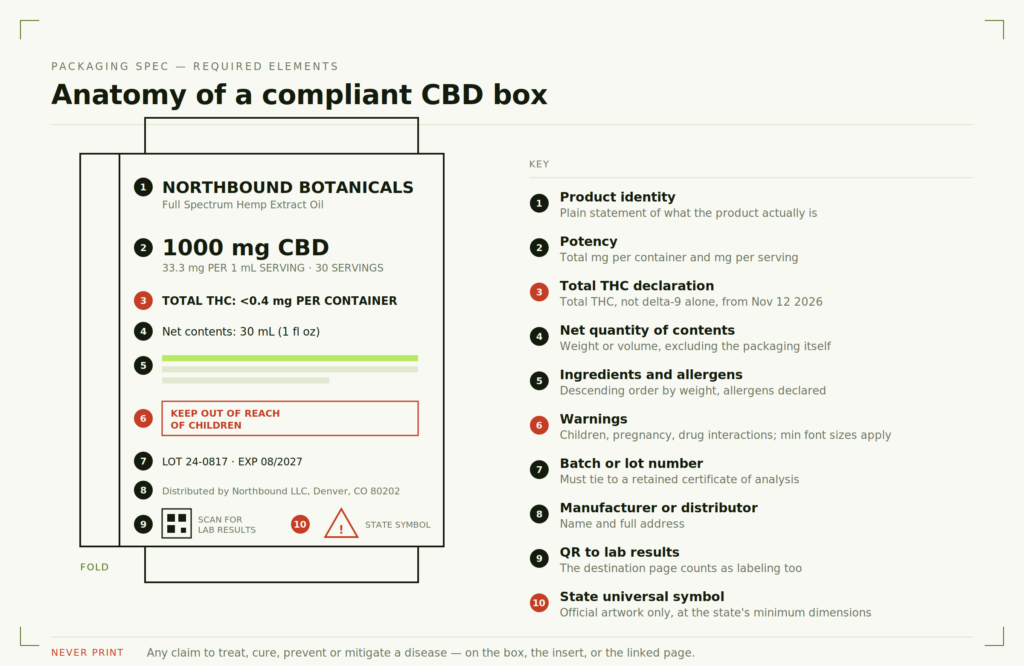
Minimum CBD label elements
| Element | Requirement |
|---|---|
| Product identity | Clear statement of what the product is |
| Net quantity of contents | Weight for solids, volume for liquids, excluding packaging |
| CBD content | Total mg per container and mg per serving |
| Total THC content | Increasingly expected, and essential for full-spectrum |
| Ingredient list | Descending order by weight, allergens declared |
| Batch / lot number | Must tie to a retained COA |
| Manufacturer or distributor | Name and full address |
| Warnings | Keep out of reach of children; pregnancy and drug-interaction cautions |
| Date information | Manufacture and/or expiration date |
| Disclaimers | No structure/function claim without the required disclaimer language |
| Prohibited | Any disease, cure, or treatment claim |
Labeling for food-format products must also follow 21 CFR Part 101.
One 2026-specific trap: enforcement now reaches past the physical label to the QR-linked destination. If your box carries a QR code to a Certificate of Analysis page, that page and any linked marketing copy are treated as labeling. Clean the box, then clean the landing page.
Cannabis labeling requirements vs. CBD labeling: what’s the difference?
Brands conflate these constantly, and the distinction determines your entire packaging spec.
Hemp-derived CBD (currently under the federal threshold) is regulated primarily as a consumer product: FD&C Act labeling rules, FTC advertising rules, plus whatever state hemp program applies. Child-resistant packaging is not universally mandated federally, though several states require it and product liability exposure makes it advisable regardless.
State-legal cannabis / THC products are regulated by a state cannabis agency and carry a much heavier structural burden: mandatory child resistance, opacity, tamper evidence, resealability, a state universal symbol, extensive warning text, and track-and-trace integration.
The overlap is growing. As the total-THC standard lands, a meaningful share of full-spectrum CBD products will be pushed toward cannabis-style regulation or off the market.
What are cannabis packaging regulations by state?
Child resistance is the one near-universal requirement. Every legal adult-use market references the PPPA standards at 16 CFR §§ 1700.15 and 1700.20 as its floor. Beyond that, states diverge sharply.
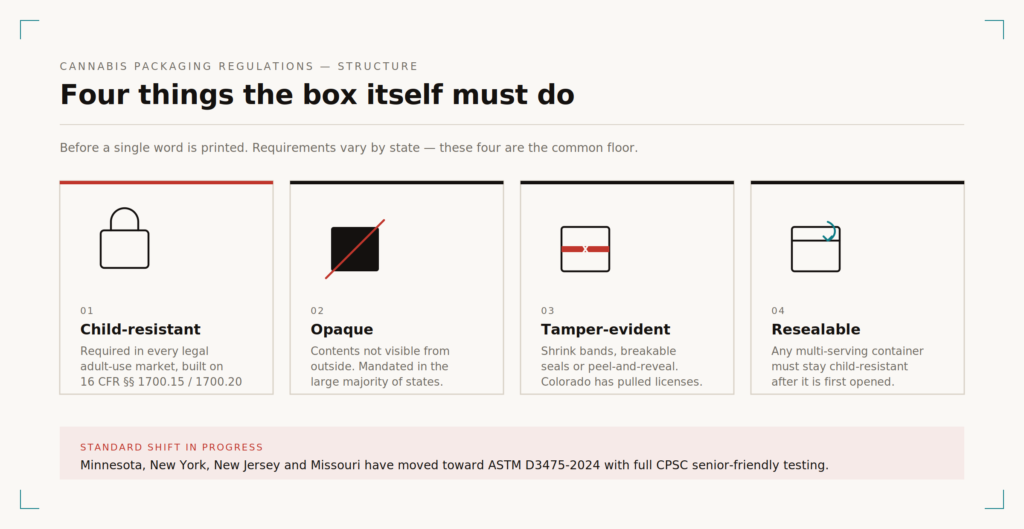
Structural requirements
- Child-resistant: Required across all adult-use markets. Note the shift underway — Minnesota, New York, New Jersey, and Missouri have moved toward ASTM D3475-2024 with full CPSC senior-friendly testing, rather than relying on the older poison-prevention standard alone. Packaging certified years ago may not carry forward.
- Opaque: Required in the large majority of adult-use states. Contents must not be visible.
- Tamper-evident: Shrink bands, breakable seals, or peel-and-reveal closures. Colorado enforcement actions have pulled licenses over missing tamper evidence.
- Resealable: Required for any multi-serving container, so it remains child-resistant after first opening.
The universal THC symbol
Most adult-use states mandate a state-specific symbol, and several publish official artwork files that must be used without alteration:
- California: a red exclamation mark inside a triangle, paired with “THC”
- Colorado: a diamond-shaped “THC!” mark, minimum 0.5″ × 0.5″ on packaging, and stamped into edibles where feasible
- New York: universal symbol plus minimum warning font size (1/16 inch), with strict plain-packaging limits and no imagery appealing to minors
Exit packaging
Some states regulate what leaves the store, not just what holds the product. New York requires an opaque, child-resistant exit bag that fully conceals the packaging inside, sealed at point of sale, carrying only the dispensary name and the universal symbol.
Extended producer responsibility
EPR is the newest layer. Several states now impose registration, reporting, and fee obligations on packaging producers. It rarely changes your artwork, but it changes your cost model and your material choices.
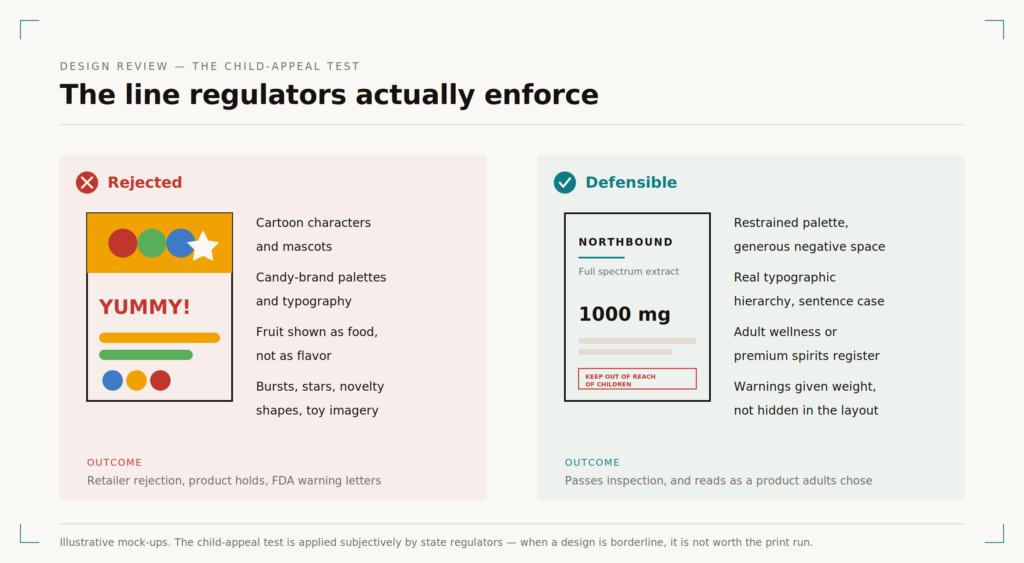
What makes CBD or cannabis packaging “attractive to children”?
Regulators apply this test aggressively, and it is one of the most common design rejections. Avoid:
- Cartoon characters, mascots, or animated figures
- Imitation of existing candy or snack brands, including color palettes and typography
- Toys, bright primary-color-dominant schemes, or novelty shapes
- Fruit imagery presented as food rather than as flavor indication
- Any name or design element referencing children’s media
Design toward an adult wellness or premium spirits register instead: restrained palettes, generous negative space, real typographic hierarchy
How do you future-proof CBD boxes before the November deadline?
Practical guidance for anyone ordering custom CBD packaging in the second half of 2026:
1. Separate the durable from the volatile. Put brand identity, structure, and finish on the printed box. Put potency figures, batch numbers, COA codes, and compliance text on an applied label or a dedicated panel you can revise without retooling.
2. Design to the strictest standard, then subtract. For multi-state operators, the efficient path is engineering to the most demanding jurisdiction typically California and adjusting copy per state. One structural base, many label variants, manageable minimum order quantities.
3. Shorten your print runs through the transition. Ordering twelve months of inventory in September 2026 is a bet against a statutory deadline. Order to a horizon you can actually forecast.
4. Audit total THC now, not in November. Request COAs that report total THC, not delta-9 alone. If a SKU fails the new math, you need reformulation lead time, not a packaging fix.
5. Reserve label real estate. Leave physical space in the layout for warnings and symbols you do not yet need. Adding a required element to a maxed-out label means starting the design over.
6. Keep your test documentation. Child-resistance certification from an accredited lab, retained on file and matched to the exact package configuration you ship.
CBD Packaging Compliance Checklist
- Potency verified by a third-party lab and matching the printed label
- Total THC (not just delta-9) tested and documented
- Net quantity stated correctly, excluding packaging
- Full ingredient list with allergen declarations
- Batch/lot number linked to a retained COA
- Manufacturer or distributor name and address
- Keep out of reach of children” and applicable health warnings
- Zero disease, cure, or treatment claims on box, insert, and QR destination
- Child-resistant certification on file, matched to the shipped configuration
- Opacity, tamper evidence, and resealability confirmed against each target state
- Correct state universal symbol at required dimensions, unaltered artwork
- Warning text at or above minimum font size for each state
- Nothing in the design that a regulator could call child-appealing
- EPR registration confirmed where applicable
- Reprint plan in place ahead of November 12, 2026
Frequently asked questions
Do CBD products need child-resistant packaging?
Federal law does not impose a blanket child-resistant requirement on all hemp-derived CBD. Several states do, particularly for edibles and any ingestible format, and the Poison Prevention Packaging Act carries civil and criminal exposure where it applies. For gummies, tinctures, and anything a child could mistake for food, child-resistant packaging is the correct default regardless of the minimum.
Can I print health benefits on my CBD box?
No. Any claim that a product treats, cures, prevents, or mitigates a disease makes it an unapproved drug under the FD&C Act. This is the most common trigger for FDA warning letters. The restriction applies to your website and QR-linked pages as well as the box.
What is the new THC limit for hemp products?
From November 12, 2026, hemp is defined by total THC at 0.3% or less on a dry weight basis, and finished hemp-derived cannabinoid products are capped at 0.4 mg of total THC per container. Before that date, the 2018 Farm Bill’s 0.3% delta-9 standard remains the operative federal test.
Is a printed outer carton the same as a “container” under the new law?
The statutory definition points to the innermost wrapping in direct contact with the product. FDA was directed to add specificity on this term and had not published it as of mid-2026, so treat marginal cases conservatively and confirm with counsel.
Do CBD labeling rules differ from state to state?
Substantially. States set their own requirements for warning language, font sizes, symbols, QR codes, and testing disclosure, and some permit CBD in food or supplements within their borders despite the federal position. Verify every state you ship into.
What happens if my CBD packaging is not compliant?
Consequences range from retailer rejection and product holds to warning letters, mandatory recalls, product seizure, civil penalties, and in licensed cannabis markets license suspension.
When do I need to update my packaging? Before November 12, 2026, if any SKU contains THCA, delta-8, converted cannabinoids, or more than 0.4 mg total THC per container. Given design, proofing, and print lead times, work backward from that date rather than toward it.
This guide is a practical overview for packaging decisions, not legal advice. Federal hemp law is in active flux multiple bills to delay, repeal, or replace Section 781 have been introduced, and FDA guidance remains outstanding. Verify your obligations with qualified cannabis regulatory counsel and your state agency before committing to a print run.